

Phillips & Associates, a dedicated employment law firm in New York, helps employees prove that their employers retaliated against them for reporting workplace issues. This guide explains how to identify illegal retaliation, preserve critical evidence, and access the right legal resources. You will learn the specific steps to build a strong case and understand the protections available under New York and federal law. according to New York City
Understanding Retaliation in New York
Workplace retaliation is an adverse action taken by an employer in response to an employee's protected activity. In New York, the law provides robust protections for employees who report harassment, discrimination, or safety violations. The New York State Department of Labor defines retaliation as an action taken against an employee to punish them for complaining about labor law violations or participating in legal proceedings. The Department of Labor emphasizes that employers cannot punish employees for exercising their legal rights.
The Role of an Employment Retaliation Attorney
Working with a specialized employment retaliation attorney is often the most effective way to prove your case. These legal professionals understand the complex interplay between federal and state laws. They can assess the strength of your claim and guide you through the complaint process. Phillips & Associates focuses on employee-side claims, including employment discrimination and retaliation.
Why Specialization Matters
Retaliation cases require a specific legal framework to prove causation. You must show that the adverse action was a direct result of your protected activity. A generalist lawyer may miss these nuances. An employment attorney knows how to navigate the Equal Employment Opportunity Commission (EEOC) and the New York State Division of Human Rights. They can also help you understand the New York State sexual harassment laws that often overlap with retaliation claims.
Choosing the Right Firm
When selecting a firm, look for experience in handling cases against large employers. Phillips & Associates has offices in New York City, Long Island, and White Plains, providing local expertise. They also handle cases in Philadelphia, Princeton, and Miami. Reviewing a firm's litigation record can give you insight into their success rate. A firm that specializes in sexual harassment and retaliation will be better equipped to handle the emotional and legal complexities of your case.
Evidence Preservation Strategies
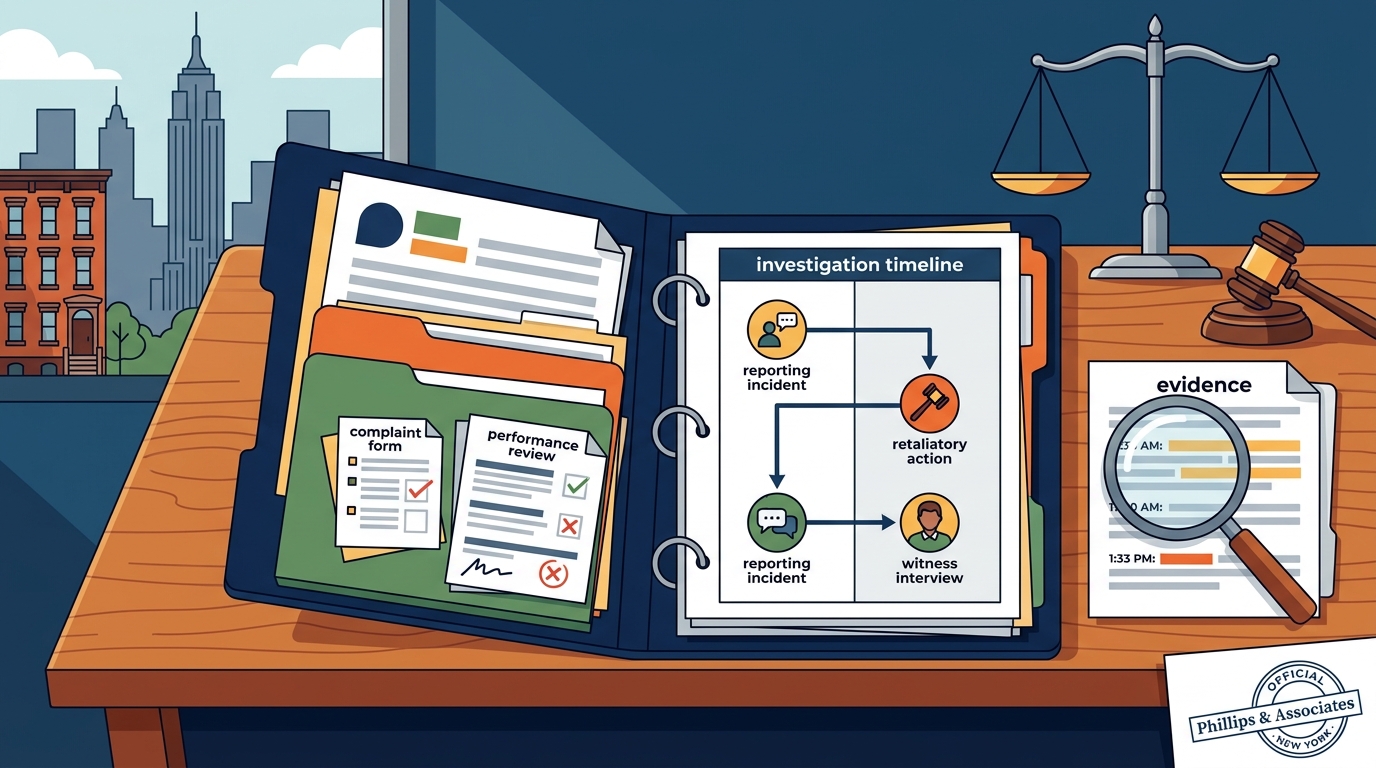
Proving retaliation requires a clear timeline of events. You must document the protected activity, the adverse action, and the causal link between them. Evidence preservation is critical because employers often destroy documents or alter records after a complaint is filed. Start by keeping a personal journal of all incidents. Record dates, times, locations, and the names of witnesses.
Documenting Adverse Actions
Save all emails, text messages, and performance reviews. If you receive a negative review after reporting an issue, keep a copy. Note any changes in your job duties or schedule. For example, if you were previously assigned to client-facing roles and are suddenly moved to a back-office position, document this change. The Benefits Path guide highlights the importance of showing a temporal connection between the complaint and the punishment.
Witness Statements
Identify colleagues who witnessed the harassment or the retaliation. Ask them to write down their recollections while they are fresh. Witness statements can be powerful evidence in court. However, be cautious about asking coworkers to sign formal affidavits without legal advice. Your attorney can help you determine the best way to gather this information.
Legal Aid and Government Resources
New York offers several government resources for employees who believe they have been retaliated against. These agencies can investigate your complaint and provide remedies. You do not need to hire a private attorney to file a complaint with these agencies, though having one can be beneficial.
Government Agencies
The Equal Employment Opportunity Commission (EEOC) handles federal complaints. The New York State Division of Human Rights and the New York City Commission on Human Rights handle state and local complaints. The New York City Commission on Human Rights provides information on their complaint process. For labor law violations, the New York State Department of Labor is the primary agency. Employees in New York City can also contact the Department of Investigation if they report corruption or misconduct to that office. The Department of Investigation protects whistleblowers who report to them.
Legal Aid Organizations
If you cannot afford a private attorney, legal aid organizations can provide free or low-cost assistance. The New York City Bar maintains a directory of legal aid providers. These organizations can help you file complaints and navigate the legal system. They are particularly helpful for employees who have been retaliated against for reporting wage theft or safety violations. according to Workplace Retaliation Your
Comparison of Legal Resources
| Resource Type | Agency or Organization | Primary Focus | Cost |
|---|---|---|---|
| Private Attorney | Phillips & Associates | Comprehensive legal representation, litigation, and negotiation | Contingency fee or hourly |
| Federal Agency | EEOC | Federal discrimination and retaliation claims | Free |
| State Agency | NY State DOL | Labor law violations and retaliation | Free |
| Local Agency | NYC Commission on Human Rights | Local discrimination and harassment claims | Free |
| Legal Aid | NYC Bar Legal Aid Directory | Free or low-cost legal assistance | Free or sliding scale |
Key Takeaways
- Specialized employment attorneys are best equipped to prove the causal link between protected activity and adverse action.
- Evidence preservation is critical. Keep a detailed journal and save all relevant documents.
- Government agencies like the EEOC and NY State DOL offer free complaint processes.
- Legal aid organizations can provide free or low-cost assistance if you cannot afford a private attorney.
- Phillips & Associates offers specialized representation for employees in New York and surrounding areas.
- Act quickly. Statutes of limitations apply to retaliation claims.
Frequently Asked Questions
What counts as protected activity in New York?
Protected activity includes reporting harassment, discrimination, or safety violations. It also includes participating in an investigation or filing a complaint with a government agency. according to sexual harassment training
How long do I have to file a retaliation claim?
Statutes of limitations vary by agency. For EEOC claims, you generally have 180 or 300 days. For New York State claims, you have one year. Consult an attorney to determine the specific deadline for your case.
Can I be fired for complaining about safety violations?
No. The New York State Department of Labor protects employees who report safety violations. Firing an employee for this reason is illegal retaliation.
Do I need a lawyer to file a complaint with the EEOC?
No, you can file a complaint with the EEOC without a lawyer. However, having a lawyer can help you navigate the process and build a stronger case.
What if my employer destroys evidence?
If your employer destroys evidence, this can be used against them in court. Your attorney can file a motion to compel the production of documents or seek sanctions for spoliation of evidence.
How much does it cost to hire an employment attorney?
Many employment attorneys work on a contingency fee basis, meaning they only get paid if you win your case. Some may charge hourly fees. Discuss fees with your attorney during the initial consultation.
Can I file a claim if I am a temporary worker?
Yes. Temporary workers are protected from retaliation. Both the staffing agency and the host employer may be held liable for retaliatory actions.