

When workplace decisions, harassment, or retaliation appear connected to race, color, or association with a person of a particular race, an EEOC charge may be an important step toward protecting your rights. The process is not simply a matter of filling out a form. You must identify the correct employer, describe the discriminatory conduct clearly, preserve supporting evidence, and file before the applicable deadline.
For most covered New York employers, the EEOC filing period for race discrimination is generally 300 days from the discriminatory act. That deadline can be shorter or different in some situations, and a separate lawsuit may involve additional deadlines. If you believe you have experienced discrimination, speak with a qualified New York racial discrimination attorney promptly rather than waiting until the deadline is close.
What is an EEOC charge?
An EEOC charge is a signed statement asserting that an employer, employment agency, labor organization, or another covered organization engaged in unlawful employment discrimination. The charge asks the U.S. Equal Employment Opportunity Commission to take action under the federal laws it enforces, including Title VII of the Civil Rights Act of 1964.
For information about the federal agency's role in workplace cases, see this overview of EEOC claims and employment law. A charge usually must be filed before an employee can bring a federal Title VII lawsuit based on race discrimination. Filing a charge does not automatically mean the EEOC will file a lawsuit, and it does not guarantee a particular result.
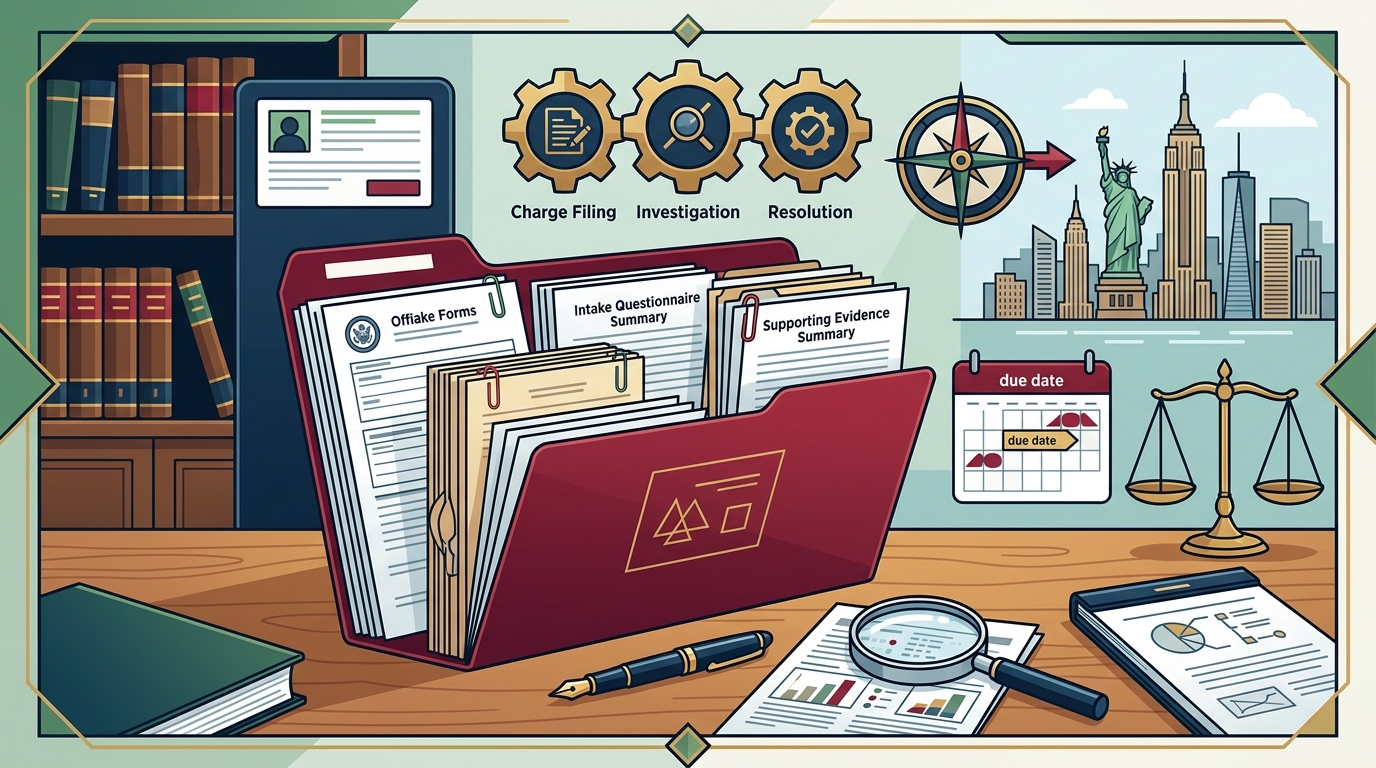
The formal document is commonly known as EEOC Form 5. It requests identifying information, employer details, the dates of the alleged discrimination, the legal bases involved, and a factual explanation of what occurred.
What workplace conduct may justify a race discrimination charge?
Race discrimination can occur in hiring, assignments, compensation, discipline, promotion, termination, scheduling, training, performance evaluations, benefits, or other terms and conditions of employment. Federal law can also address discrimination based on color and certain forms of discrimination because of a person's association with someone of a particular race.
Examples of potentially discriminatory treatment
- A qualified employee is denied a promotion while a less-qualified person of another race is selected, especially where decision-makers make race-related remarks or apply inconsistent criteria.
- An employee receives harsher discipline than similarly situated coworkers of another race for comparable conduct.
- A manager assigns undesirable shifts, duties, territories, or work locations based on race.
- An employer pays workers differently for substantially similar work and race appears to be a factor.
- An applicant is rejected after a hiring manager expresses a racial preference.
- An employee is terminated, demoted, or isolated after reporting race discrimination.
- Racial slurs, symbols, threats, jokes, stereotypes, or repeated offensive comments create a hostile work environment.
For additional discussion of harassment that may be actionable, review this guide to a race-based hostile work environment.
Disparate treatment and hostile work environment claims
Disparate treatment generally involves an employer treating an employee or applicant differently because of race. The evidence may include comparator employees, inconsistent explanations, biased remarks, unusual deviations from policy, or a pattern affecting members of a racial group.
Hostile work environment claims involve race-based conduct that is sufficiently severe or pervasive to alter the conditions of employment. A single incident can be serious enough in some circumstances, while a series of less extreme incidents may become legally significant when considered together. Not every offensive comment meets the legal standard, but employees should document concerning conduct and seek advice before assuming a claim is too minor to matter.
Prepare before you submit the charge
A clear filing begins with organized facts. Before starting the online inquiry, create a private chronology that lists each important event in date order. Include who acted, what was said or done, where it occurred, who witnessed it, how you responded, and what happened afterward.
Evidence to preserve
- Emails, text messages, chat messages, letters, and written directives.
- Performance reviews, disciplinary notices, compensation records, schedules, and promotion materials.
- Employee handbook provisions and relevant workplace policies.
- Names and contact information for people who saw or heard the conduct.
- Notes recording racial comments, meetings, complaints, and management responses.
- Documents showing treatment of similarly situated employees.
- Records of financial losses, medical treatment, counseling, or other effects of the conduct.
- Copies of internal complaints and any response from human resources or management.
Do not obtain documents by violating a security policy, accessing records you are not authorized to see, or taking confidential client information. Preserve materials lawfully and keep copies in a safe personal location if permitted. This practical resource explains how to document a hostile work environment.
Identify the deadline before doing anything else
The filing period is measured from the date of the alleged unlawful employment practice. A termination, denial of promotion, disciplinary action, or discriminatory pay decision may have a specific date. Harassment may involve multiple events, but you should not assume that a continuing pattern automatically makes every old incident timely. Retaliation may have its own filing date.
Write down the last date of each potentially unlawful event. If the deadline may be approaching, contact the EEOC and an attorney immediately. If your concern involves racist comments or behavior by a supervisor, do not wait for the behavior to escalate before obtaining advice.
How to file an EEOC charge in New York: step by step
Step 1: Start an inquiry with the EEOC
The usual online starting point is the EEOC Public Portal. The portal generally allows you to submit an inquiry, provide preliminary information, and schedule an intake interview. The EEOC may ask questions designed to determine whether it is the appropriate agency and whether the matter appears to fall within a filing deadline.
Use an email address and telephone number that you can reliably access. Keep your login information secure, and save confirmation messages or appointment details.
Step 2: Provide a focused factual narrative
Explain the events in a way that lets an investigator understand the claim without guessing. A useful narrative answers five questions:
- Who: Identify the employer, decision-makers, supervisors, human resources personnel, and witnesses.
- What: Describe the action, statement, policy, comparison, or harassment.
- When: Give exact dates when known and reasonable date ranges when they are not.
- Where: State whether the conduct occurred at a worksite, remotely, by telephone, by email, or elsewhere.
- Why: Explain the facts suggesting race, color, or retaliation was a motivating factor.
Avoid unsupported conclusions such as “everyone was biased” without explaining the events behind that belief. At the same time, do not omit important facts merely because they seem unfavorable. Accuracy and completeness are more useful than exaggeration.
Step 3: Attend the intake interview
The EEOC may conduct an interview by telephone, video, or in person. New York employees may also contact the EEOC's New York District Office. The source article identifies the office at 33 Whitehall Street, 5th Floor, New York, NY 10004; confirm current office procedures and appointment requirements before appearing.
Bring or organize your chronology, the names of witnesses, and the documents most directly connected to the claim. If you need an interpreter, disability-related assistance, or another accommodation, request it promptly.
Step 4: Review and sign the formal charge
After the inquiry and interview, the EEOC may prepare the formal charge for your review. You or your attorney should check the employer's legal name, addresses, dates, discrimination categories, and factual allegations carefully. Correct inaccuracies before signing.
A charge is not a full trial brief, but it should identify the important events and legal theories. If the charge leaves out an event, decision-maker, protected basis, or retaliation allegation, it may complicate the agency process or later litigation. An experienced racial discrimination lawyer can help evaluate the wording and preserve related claims.
Step 5: Keep proof that the charge was filed
Save the completed charge, confirmation of submission, charge number, correspondence, appointment records, and every document uploaded to the portal. Update the EEOC if your address, telephone number, or email changes. Missing an agency communication can harm your ability to respond or act on a right-to-sue notice.
| Filing route | What it involves | When it may be useful |
|---|---|---|
| EEOC Public Portal | Submit an online inquiry, schedule an intake, and complete the charge electronically. | Convenient for most employees and available for tracking case information. |
| EEOC office | Schedule a telephone, video, or in-person appointment; walk-in procedures may vary. | Helpful when you need assistance or cannot use the online system. |
| Send a signed written charge or letter containing the required identifying and factual information. | Useful for employees who cannot access the portal, but mailing time and proof of delivery must be considered. | |
| Attorney assistance | An attorney may help prepare, review, and submit the charge and communicate with the agency. | Especially valuable when facts are complex, several laws may apply, or a deadline is close. |
How long do you have to file in New York?
The ordinary federal deadline for a Title VII charge is 180 calendar days after the alleged discriminatory act. That period can extend to 300 days when a state or local agency enforces a law prohibiting discrimination on the same basis. The EEOC's New York District Office states that individuals generally have 300 days to file race, color, national-origin, sex, religion, or disability discrimination charges against employers with at least 15 employees in New York and certain neighboring states. See the EEOC's current New York timeliness guidance.
Employer size matters. Title VII generally covers private employers with 15 or more employees. If the employer has fewer than 15 employees, a federal Title VII claim may not be available, but New York State or New York City law may still provide protection. The applicable deadline and filing forum can differ, so do not rely on the 300-day period without confirming the facts.
For example, if an employee was fired on January 10, 2026, the filing deadline may be calculated differently depending on employer size, the law being used, and whether the conduct is a discrete act or part of a continuing pattern. A lawyer or agency should calculate the actual deadline rather than using an estimate.
What happens after the EEOC charge is filed?
Notice to the employer
The EEOC generally notifies the named employer that a charge has been filed. The agency may request a position statement, personnel records, policies, electronic communications, or other information. The employer may deny the allegations, offer a different explanation, or assert defenses.
Mediation or investigation
Some charges may be offered for mediation. Mediation is voluntary and is intended to give the parties an opportunity to resolve the dispute without a full investigation. Other cases proceed through investigation, which may include reviewing documents, interviewing witnesses, and seeking responses from the parties.
The EEOC received 88,531 new discrimination charges in fiscal year 2024, so investigation timelines vary based on agency workload, the complexity of the facts, the parties' cooperation, and whether mediation is used. The agency's annual performance materials report that it resolved 87,219 charges during fiscal year 2024 and obtained more than $469.6 million in monetary relief through the administrative process. These figures describe agency-wide activity and do not predict the result or timing of an individual case.
Possible outcomes
- Settlement or mediation: The parties may reach an agreement involving money, policy changes, reinstatement, neutral references, or other terms.
- Dismissal or no-cause determination: The EEOC may close the charge without finding sufficient evidence to pursue it. That decision does not necessarily mean a court would reach the same conclusion.
- Reasonable-cause finding and conciliation: If the EEOC finds reasonable cause, it may attempt to obtain voluntary relief from the employer.
- EEOC litigation: In selected cases, the agency may bring a lawsuit, although it does not litigate every charge.
- Notice of Right to Sue: The EEOC may issue a notice allowing the charging party to pursue a lawsuit. A Title VII plaintiff generally has 90 days after receiving the notice to file in court.
In many situations, an employee may request a Notice of Right to Sue after 180 days have passed since filing, subject to the EEOC's rules and the status of the charge. If you receive a notice, review it with an attorney immediately. This resource explains what to do after receiving a right-to-sue letter.
Should you file with New York State or New York City?
The EEOC is not the only potential forum. The New York State Human Rights Law and the New York City Human Rights Law may cover conduct that also violates federal law, and those laws can apply to smaller employers in circumstances where Title VII does not.
The New York City Human Rights Law generally covers employers with four or more employees. New York State and New York City laws may also provide different remedies, definitions, and filing periods. Whether to proceed under federal, state, city, or multiple laws depends on the employer's location, size, the type of conduct, and the dates involved.
The EEOC and state or local fair-employment agencies may use work-sharing and dual-filing arrangements. When a charge is filed with one agency, it may be transmitted to the other agency under the applicable arrangement. Confirm that the charge identifies the correct agency and requests dual filing when appropriate. Do not assume that filing in one forum automatically preserves every possible claim or deadline.
Common mistakes that can weaken an EEOC filing
- Waiting for more evidence: Evidence can be gathered after filing, but waiting may cause the deadline to expire.
- Listing only conclusions: Explain the events, comparators, statements, dates, and consequences supporting your belief.
- Leaving out retaliation: If negative treatment began after you complained or participated in an investigation, identify the complaint and subsequent acts.
- Naming the wrong entity: Verify the employer's legal name and identify parent companies, staffing agencies, or other responsible entities when relevant.
- Ignoring smaller-employer coverage: If Title VII does not apply, state or city law may still matter.
- Missing agency communications: Monitor the portal and preserve every notice.
- Assuming an EEOC charge is a lawsuit: A charge starts an administrative process; it does not by itself commence a court case.
- Discussing confidential strategy publicly: Avoid posting detailed allegations or confidential documents on social media.
Key takeaways
- An EEOC charge is generally required before filing a federal Title VII race discrimination lawsuit.
- New York employees commonly have 300 days to file a race discrimination charge with the EEOC, but employer size, claim type, and filing forum can change the analysis.
- Start with the EEOC Public Portal, an EEOC office, mail, or an attorney.
- Use a timeline and specific facts rather than unsupported conclusions.
- Preserve emails, messages, evaluations, discipline records, witness information, and evidence of unequal treatment.
- Race discrimination may involve disparate treatment, hostile work environment harassment, discriminatory compensation, or retaliation.
- New York State and New York City laws may offer additional protections, including coverage for some smaller employers.
- If you receive a Notice of Right to Sue, the 90-day federal court deadline is critical.
Frequently asked questions
Can I file an EEOC charge without a lawyer?
Yes. Employees may begin through the EEOC Public Portal, contact an EEOC office, or submit a signed charge by mail. An attorney is not required, but legal assistance may be useful when the facts involve multiple discriminatory acts, retaliation, several employers, disputed comparators, or a deadline that is approaching.
What should I say in the race discrimination narrative?
Describe the employer, decision-makers, discriminatory acts, dates, locations, witnesses, comparable employees, complaints you made, and the consequences you experienced. Explain the facts connecting the conduct to race or color. Keep the account truthful, specific, organized, and supported by documents where possible.
How long do I have to file an EEOC charge in New York?
For many race discrimination claims against employers with at least 15 employees, the New York District Office identifies a 300-day period. The ordinary federal period is 180 days, and different rules may apply to smaller employers, public employers, continuing harassment, or claims under New York law. Obtain a deadline calculation promptly.
What if my employer has fewer than 15 employees?
Title VII generally applies to employers with 15 or more employees, but a smaller employer may still be covered by the New York State Human Rights Law or the New York City Human Rights Law. New York City law generally reaches employers with four or more employees. The facts and applicable jurisdiction should be reviewed individually.
Does filing with the EEOC also file a claim with New York?
A work-sharing agreement may allow a charge filed with the EEOC to be dual-filed with a state or local fair-employment agency. Confirm the filing designation and do not assume that every state or city claim is automatically preserved.
What happens if the EEOC dismisses my charge?
The EEOC may issue a dismissal and Notice of Right to Sue. A dismissal is not necessarily a judicial finding that the discrimination did not occur. If you receive the notice, consult counsel promptly because federal law generally provides 90 days to file a lawsuit after receipt.
How long does an EEOC investigation take?
There is no guaranteed timetable. Mediation can resolve some matters more quickly, while investigations involving many witnesses, extensive records, or complicated legal issues can take substantially longer. Monitor your case and respond to agency requests on time.
What remedies may be available?
Depending on the law and facts, remedies may include back pay, front pay, compensation for emotional distress, punitive damages, reinstatement, hiring, promotion, attorney's fees, policy changes, and other equitable relief. Available remedies vary under federal, New York State, and New York City law.
Discuss your potential race discrimination claim
Deadlines can expire while an employee is still trying to understand what happened or gather proof. The New York employment discrimination attorneys at Phillips & Associates represent employees in race discrimination, harassment, retaliation, and related workplace claims. The firm states that it has recovered more than $300 million for victims of workplace discrimination and harassment. To discuss your situation, schedule a free, confidential consultation or call (866) 229-9441.
This article provides general information and is not a substitute for advice from an attorney who can evaluate your facts, deadlines, employer size, and available claims.