

Filing a discrimination claim is your legal right, but many New York employees face punishment from their employers for exercising it. Retaliation is the most common type of charge filed with the Equal Employment Opportunity Commission (EEOC), accounting for 42,301 charges in fiscal year 2024 alone. If your employer has demoted you, cut your hours, or fired you after you reported discrimination, you are not powerless. New York workers have some of the strongest anti-retaliation protections in the country under federal, state, and city law. Here is exactly what you should do to protect yourself and build a strong case.
What Is Workplace Retaliation?
Workplace retaliation is any adverse action an employer takes against an employee for engaging in a legally protected activity. Protected activity includes filing a discrimination complaint, participating in a workplace investigation, reporting harassment, or supporting a coworker's claim. Under the law, your employer cannot punish you for speaking up, even if the underlying complaint is not ultimately proven correct.
The EEOC defines retaliation broadly. It covers obvious actions like termination and demotion, but also subtler moves such as schedule changes, exclusion from meetings, or suddenly negative performance reviews. In fiscal year 2024, retaliation charges were the most prevalent filings with the EEOC for the seventeenth consecutive year.
Recognizing the Signs of Retaliation
Retaliation is not always a dramatic firing. Employers have become savvier about disguising retaliatory conduct. Common examples of retaliation include:
- Termination or failure to rehire
- Demotion or reassignment to a less favorable position
- Reduction in pay or hours
- Unwarranted negative performance evaluations
- Exclusion from projects, meetings, or training
- Increased micromanagement or scrutiny
- Threats related to immigration status
A constructive discharge is another form of retaliation where your employer does not fire you outright but makes conditions so intolerable that a reasonable person would feel forced to resign. If these changes began shortly after you filed a complaint, timing alone can be significant evidence. Learn more about examples of workplace retaliation and how they are identified.
Laws That Protect You in New York
New York employees benefit from three layers of legal protection against retaliation.
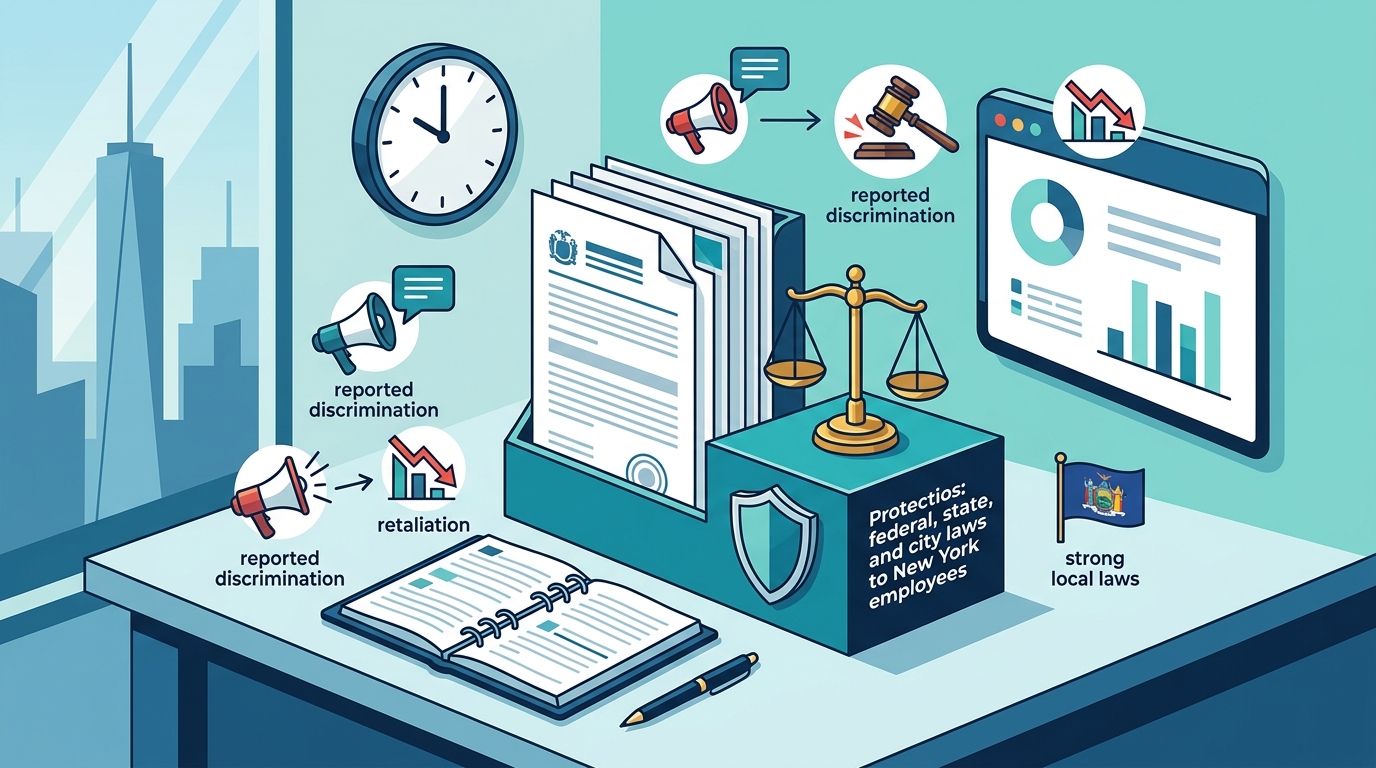
Federal Law: Title VII and the ADA
Title VII of the Civil Rights Act of 1964 prohibits retaliation against employees who oppose discrimination based on race, color, gender, national origin, pregnancy, or religion. The Americans with Disabilities Act (ADA) similarly protects employees who file disability-related complaints. Under federal law, you must show that but for your protected activity, the adverse action would not have occurred.
New York State Human Rights Law (NYSHRL)
The NYSHRL mirrors federal protections but covers a broader set of protected categories and applies to employers with four or more employees. The New York State Human Rights Law also uses the same burden-shifting framework established in McDonnell Douglas v. Green for analyzing retaliation claims.
New York City Human Rights Law (NYCHRL)
The NYCHRL is considered one of the broadest anti-discrimination and anti-retaliation laws in the nation. Unlike federal law, it does not require a material change in employment terms to establish retaliation. The city law prohibits retaliation "in any manner," making it far more protective for NYC workers. Phillips & Associates' workplace retaliation attorneys are experienced in leveraging all three of these legal frameworks.
Steps to Take After Employer Retaliation
1. Document Everything
Start keeping a detailed written record immediately. Save emails, text messages, performance reviews, and any written communication related to the adverse action. Note dates, times, witnesses, and exact statements. A strong paper trail is often the backbone of a successful retaliation case.
2. File an Internal Complaint
Report the retaliation through your company's HR department or internal grievance process. Put the complaint in writing and keep a copy. While internal complaints alone may not always trigger all legal protections, they create a documented record of your employer's awareness.
3. Consult an Employment Attorney
An experienced New York retaliation lawyer can evaluate your situation, identify applicable laws, and advise on whether to file with the EEOC, the NYC Commission on Human Rights, or directly in court. Phillips & Associates offers free, confidential consultations and operates on a contingency fee basis, meaning you pay nothing unless you recover compensation.
How to Prove a Retaliation Case
To establish a retaliation claim, you generally need to prove three elements: (1) you engaged in a protected activity, (2) your employer took an adverse action against you, and (3) there is a causal connection between the two. The causal nexus is the most contested element.
Timing is a powerful form of evidence. If you were terminated within days or weeks of filing a complaint, the close temporal proximity creates a strong inference of retaliation. Courts also look at whether your employer's stated reasons changed over time. In one recent New York case, a supervisor's story shifted from praising an employee's remote work performance to suddenly criticizing it only after the employee filed a lawsuit, which the court found could suggest retaliatory motive.
Your employer will likely argue the adverse action was based on legitimate reasons like poor performance. Having documentation of strong prior reviews and consistent treatment compared to coworkers helps counter these defenses. Even if your underlying discrimination claim fails, you may still have a winning retaliation case as long as your original complaint was made in good faith. Learn more about how multiple legal standards can support a retaliation case in New York.
Federal vs. State vs. City Retaliation Standards
| Factor | Title VII / ADA (Federal) | NYSHRL (State) | NYCHRL (City) |
|---|---|---|---|
| Employer size | 15+ employees | 4+ employees | 4+ employees |
| Causation standard | "But for" causation | "But for" causation | Motivating factor (more lenient) |
| Adverse action required | Materially adverse | Materially adverse | Any retaliatory conduct |
| Scope of protected activity | Opposition or participation | Broader than federal | Broadest; covers more categories |
| Filing deadline | 300 days (EEOC) | 3 years | 3 years |
This comparison highlights why experienced New York employment attorneys often pursue claims under the NYCHRL, which offers the most employee-friendly standards.
Key Takeaways
- Retaliation is the single most common charge filed with the EEOC, with over 42,000 charges in fiscal year 2024.
- Workplace retaliation is any adverse action taken against you for engaging in protected activity like filing a discrimination complaint.
- New York City's Human Rights Law offers broader protections than federal or state law and does not require a material change in employment.
- Document everything: emails, reviews, witnesses, and dates create the foundation of your case.
- You can still win a retaliation claim even if your original discrimination complaint is not proven.
- Timing matters: adverse actions shortly after a complaint create a strong inference of retaliation.
- Consult an attorney before filing, as different laws have different standards and deadlines.
Frequently Asked Questions
What counts as a protected activity in a retaliation claim?
A protected activity is any action that opposes workplace discrimination or participates in a legal process related to it. This includes filing a complaint with HR or the EEOC, supporting a coworker's claim, testifying in an investigation, requesting a reasonable accommodation, or reporting harassment.
Can I be retaliated against even if my discrimination claim is not proven?
Yes. As long as you filed your complaint in good faith and had a reasonable belief that discrimination occurred, your employer cannot punish you. The retaliation claim is analyzed separately from the underlying discrimination claim.
What should I do first if I think my employer is retaliating?
Begin documenting every retaliatory action with dates, times, and details. Save all relevant communications. Then consult a qualified workplace retaliation attorney to discuss your options.
How long do I have to file a retaliation claim in New York?
Under federal law, you typically have 300 days to file a charge with the EEOC. Under New York State and New York City human rights laws, you generally have three years to file a complaint in court. These deadlines vary, so act quickly.
Does the New York City Human Rights Law offer stronger protections?
Yes. The NYCHRL is considered one of the most protective anti-retaliation laws in the country. It prohibits retaliation in any manner and does not require a material change in employment terms, unlike federal law.
Can my employer claim they fired me for performance reasons?
They often do. Employers frequently cite poor performance, tardiness, or restructuring as justification. However, if your performance reviews were positive before your complaint and suddenly turned negative, or if the employer's explanations shift over time, this can demonstrate pretext for retaliation.
What damages can I recover in a retaliation lawsuit?
Depending on the law and facts, you may recover back pay, front pay, compensatory damages for emotional distress, punitive damages, and attorney's fees. In some cases, reinstatement to your former position may also be ordered.
Do I need to file with the EEOC before suing?
For federal claims under Title VII or the ADA, yes. You must first file a charge with the EEOC. However, for claims under the NYSHRL or NYCHRL, you may file directly in court without going through an agency first. An attorney can help you choose the best path. Learn about whistleblower protections that may also apply to your situation.
Protect Your Rights Today
If your employer has retaliated against you for filing a discrimination claim, time is critical. The experienced employment attorneys at Phillips & Associates have recovered over $300 million for victims of workplace discrimination and harassment. Contact us at (866) 229-9441 or complete our free consultation form today. We do not charge a fee unless we win your case.