

How to File an EEOC Charge for Racial Discrimination in the Workplace
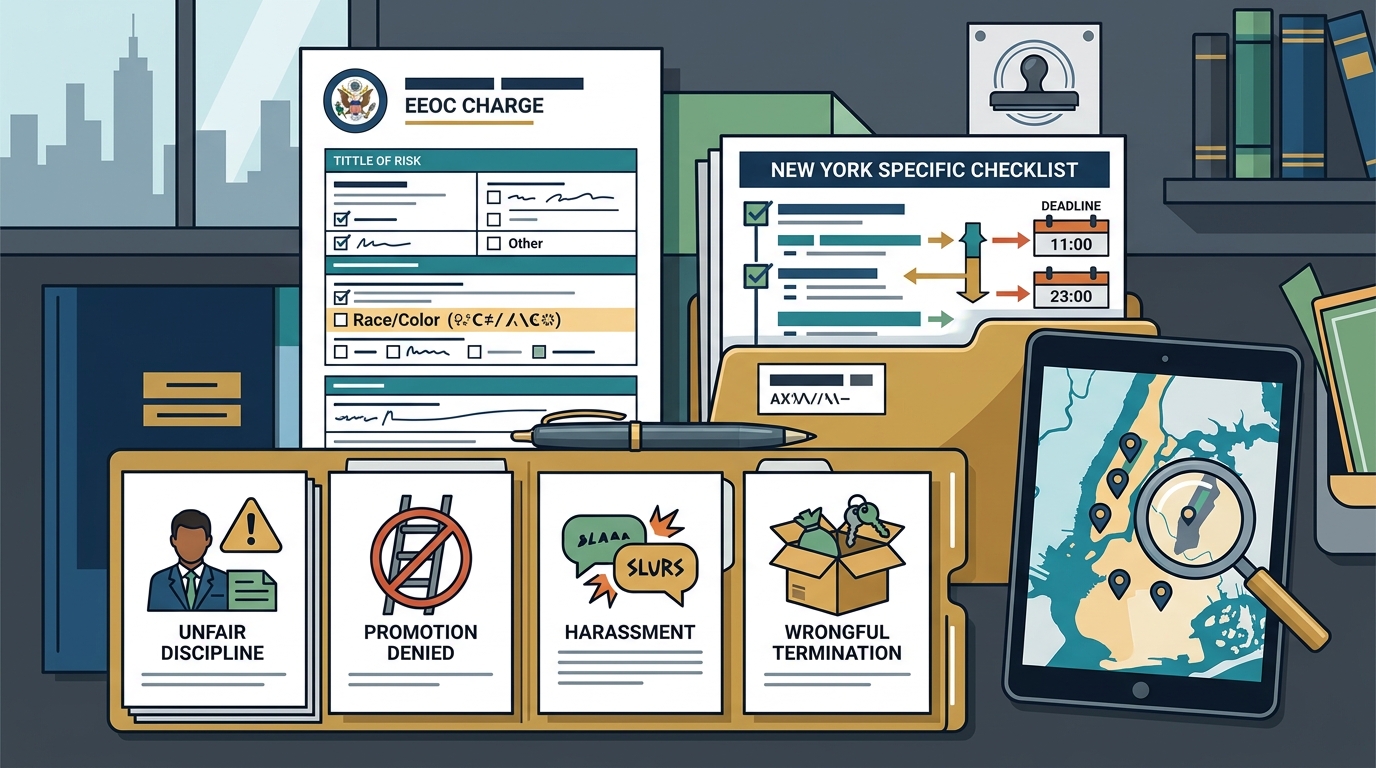
If you have experienced racial discrimination at work — whether through unfair discipline, denial of a promotion, harassment involving racial slurs, or wrongful termination — the federal Equal Employment Opportunity Commission (EEOC) is typically the first agency you must contact before you can pursue a federal lawsuit. This guide walks New York City employees through every stage of filing an EEOC charge for race-based discrimination, including critical deadlines, documentation strategies, and what happens after the charge is filed.
Why an EEOC Charge Is Required Before Filing a Federal Lawsuit
Under Title VII of the Civil Rights Act of 1964, employees are protected from workplace discrimination based on race, color, religion, sex, and national origin. However, you cannot simply file a lawsuit the moment discrimination occurs. All of the laws enforced by the EEOC — except the Equal Pay Act — require you to file a Charge of Discrimination before you can bring a job discrimination lawsuit against your employer in federal court. A charge of discrimination is a signed statement asserting that an employer engaged in employment discrimination, and it requests the EEOC to take remedial action.
Step 1: Document Every Incident of Racial Discrimination
Before you take any formal steps, start building your evidence file. Thorough documentation dramatically strengthens your position during an EEOC investigation.
What to Record
- Dates, times, and locations of each discriminatory act
- Names of individuals who engaged in or witnessed the behavior
- Exact words used — write down racial slurs, coded language, or demeaning remarks verbatim
- Emails, text messages, Slack messages, or screenshots that demonstrate bias or unequal treatment
- Performance reviews, pay stubs, and promotion records that reveal disparate treatment compared to non-minority colleagues
Documentation serves multiple purposes: it preserves details before memory fades, establishes patterns of discrimination over time, and provides concrete evidence your EEOC investigator can reference.
Step 2: Understand the Filing Deadline — It Is Strict
One of the most common mistakes employees make is waiting too long to act. The EEOC imposes strict time limits on filing a charge. In general, you need to file a charge within 180 calendar days from the day the discrimination took place. However, this 180-day filing deadline is extended to 300 calendar days if a state or local agency enforces a law that prohibits employment discrimination on the same basis.
Because New York State and New York City both have anti-discrimination agencies that enforce local laws, New York employees generally have 300 days to file an EEOC complaint. Holidays and weekends count toward the deadline, although if it falls on a weekend or holiday you have until the next business day.
Important: Each Discriminatory Event Has Its Own Deadline
If more than one discriminatory event took place, the deadline usually applies to each event separately. For example, if you were demoted and then fired a year later based on your race, the demotion has its own 180/300-day window. Filing a charge about the termination does not automatically cover the earlier demotion if its deadline has passed. The one exception is ongoing harassment — in those cases, you must file within 180 or 300 days of the last incident of harassment, although the EEOC will examine earlier incidents as well.
Step 3: Choose Where to File — Federal, State, or City
New York City workers have three overlapping layers of legal protection against racial discrimination, each with a different agency and different rules:
| Agency | Law Enforced | Employer Size Threshold | Filing Deadline |
|---|---|---|---|
| EEOC | Title VII (Federal) | 15+ employees | 300 days (in NY) |
| NY State Division of Human Rights (DHR) | NY State Human Rights Law | 4+ employees | 1 year (or 3 years for court filing) |
| NYC Commission on Human Rights (CCHR) | NYC Human Rights Law | 4+ employees | 1 year (3 years for gender-based harassment) |
The New York City Human Rights Law is one of the country's most employee-friendly laws, expanding protections to independent contractors and freelancers and requiring a lower burden of proof than federal law for harassment claims. However, you cannot file a complaint with the NYC Commission on Human Rights if you have already filed a discrimination complaint based upon the same facts with any other court or agency, including the EEOC.
For most employees pursuing a federal lawsuit, the recommended approach is to file with the EEOC first. The EEOC and the NY State Division of Human Rights have a work-sharing agreement that allows them to cross-file complaints automatically in many cases, helping preserve both your federal and state rights.
Step 4: File Your EEOC Charge
There are three ways to initiate your EEOC charge:
Option A: Online via the EEOC Public Portal
You can begin the process through the EEOC Public Portal. After submitting an online inquiry, an EEOC staff member will interview you — the agency considers this the best way to assess your situation and determine whether filing a charge is the appropriate path. The staff member will then prepare a charge using the information you provide, which you can review and sign online.
Option B: In Person at an EEOC Field Office
You may file a charge at any of the EEOC's 53 field offices. In New York City, the district office is located at 33 Whitehall Street, 5th Floor, New York, NY 10004. Your charge may be investigated at the office closest to where the discrimination occurred.
Option C: By Mail
You can also send a signed letter containing: the name, address, email, and telephone number of the employer; a short description of the actions you believe were discriminatory; and why you believe you were discriminated against (for example, because of your race). If you do not sign the letter, the EEOC cannot investigate it.
Although the EEOC does not take charges over the phone, you can call 1-800-669-4000 to discuss your situation and get the process started. A representative will ask basic questions to determine if your situation is covered by the laws the EEOC enforces.
Step 5: What Happens After You File
Once your charge is filed, a specific sequence of events unfolds:
Employer Notification
The EEOC is required by law to notify the employer that a charge has been filed. The employer typically receives a copy of the charge within approximately 10 days. The employer is then given about 30 days to submit a position statement responding to the allegations.
Mediation May Be Offered
At the start of an investigation, the EEOC will advise both parties if the charge is eligible for mediation. Mediation and settlement are voluntary resolutions — neither party can be forced to participate. Many cases are resolved at this stage, saving both sides the time and expense of a prolonged investigation.
Investigation
If mediation does not occur or fails, the EEOC conducts a formal investigation. The EEOC investigator evaluates the information submitted and makes a recommendation as to whether there is reasonable cause to believe that unlawful discrimination has taken place. The investigation lasts about 10 months on average, during which both parties provide documents, testimony, and other evidence.
Determination
There are two possible outcomes:
- No Reasonable Cause: If the EEOC is unable to conclude that discrimination occurred, you will receive a Dismissal and Notice of Rights. This notice informs you that you have the right to file a lawsuit in federal court within 90 days from the date of its receipt.
- Reasonable Cause Found: If the EEOC determines there is reasonable cause to believe discrimination occurred, both parties receive a Letter of Determination inviting them to resolve the charge through conciliation. If conciliation fails, the EEOC has the authority to file a lawsuit in federal court on your behalf — though due to limited resources it cannot do so in every case.
Step 6: Receiving Your Right-to-Sue Letter
For Title VII claims based on race, you must have a Notice of Right to Sue from the EEOC before you can file a lawsuit in federal court. Generally, you must allow the EEOC 180 days to resolve your charge, although in some cases the EEOC may agree to issue the notice earlier. Once issued, you have exactly 90 days to file your lawsuit — miss this window and your federal claims may be permanently barred.
New York-Specific Considerations for Racial Discrimination Claims
The NYSHRL Advantage
The New York State Human Rights Law provides broader protections than federal law. It applies to nearly every employer in New York, regardless of size, and carries a lower burden of proof for harassment claims. You have up to three years to file a complaint with the NY DHR or file a lawsuit in state court — significantly longer than the EEOC's 300-day deadline.
NYC Commission on Human Rights
The NYC Human Rights Law requires that the complaint be filed within one year of the last alleged act of discrimination. As of recent changes, the NYC Commission on Human Rights no longer automatically cross-files claims of employment discrimination with the EEOC. If you think you might also want to pursue the same claim in federal court, you should file separately with the EEOC as well.
Section 1981 as a Backup
If you have missed the 300-day EEOC deadline for a race-based claim, you may still have a case under 42 U.S.C. § 1981, a separate federal statute that prohibits racial discrimination in contracting (including employment) and generally carries a four-year statute of limitations. Unlike Title VII, Section 1981 does not require filing an EEOC charge first.
Common Mistakes That Can Derail Your EEOC Charge
- Waiting too long to file: The 300-day clock does not stop while you pursue internal grievances, union complaints, or mediation with your employer.
- Filing with CCHR first and losing federal options: Remember that you cannot file with the NYC Commission on Human Rights if you have already filed with the EEOC based on the same facts — and vice versa.
- Submitting vague allegations: Your charge must outline specific violations, detail the nature of the discrimination, and identify the parties involved.
- Not signing your charge: An unsigned letter or form cannot be investigated.
- Ignoring the 90-day lawsuit window: After receiving your Right-to-Sue letter, you have only 90 days to file in federal court.
Key Takeaways
- You must file an EEOC charge before pursuing a federal racial discrimination lawsuit under Title VII.
- New York employees typically have 300 days from the discriminatory act to file with the EEOC.
- You can file online through the EEOC Public Portal, in person, or by mail.
- The EEOC investigation takes roughly 10 months on average.
- After receiving a Right-to-Sue letter, you have 90 days to file a lawsuit in federal court.
- New York workers also have state (NYSHRL) and city (NYCHRL) options with different deadlines and broader protections.
- If you miss the EEOC deadline for a race claim, Section 1981 may still provide a path to court.
- An experienced New York City discrimination lawyer can help you navigate overlapping deadlines and choose the strongest filing strategy.
Frequently Asked Questions
How long do I have to file an EEOC charge for racial discrimination in New York?
Because New York has state and local agencies that enforce anti-discrimination laws, your filing deadline with the EEOC is extended from 180 days to 300 calendar days from the date of the discriminatory act. Do not wait until the last minute — gathering evidence and preparing a strong charge takes time.
Can I file a racial discrimination lawsuit without going through the EEOC?
Under federal law, no. You must file a charge with the EEOC and receive a Notice of Right to Sue before filing a Title VII lawsuit in federal court. However, under the New York State Human Rights Law, you can file a lawsuit in state court without going through the EEOC or the state Division of Human Rights first.
What happens if the EEOC dismisses my charge?
A dismissal does not mean your case is over. The EEOC will issue a Dismissal and Notice of Rights, which gives you 90 days to file your own lawsuit in federal court. Many successful racial discrimination lawsuits proceed after an EEOC dismissal.
How long does an EEOC investigation take?
On average, the investigation takes about 10 months. The EEOC aims to resolve charges within 180 days, but complex cases often take longer. You can request your Right-to-Sue letter after 180 days if you want to move to court sooner.
Can I file with both the EEOC and the New York State Division of Human Rights?
Yes. The EEOC and NYSDHR have a work-sharing agreement that allows cross-filing to preserve both federal and state rights. However, always verify with both agencies that your complaint was properly dual-filed.
What evidence do I need to file an EEOC charge?
At minimum, you need the employer's name and contact information, a description of the discriminatory acts, the dates they occurred, and an explanation of why you believe race was the motivating factor. Supporting evidence like emails, witness names, and performance records strengthen your charge significantly.
Should I hire a lawyer before filing an EEOC charge?
While you are not required to have an attorney to file an EEOC charge, consulting with a New York City discrimination lawyer before filing can help you avoid procedural mistakes, choose the best agency to file with, and preserve evidence critical to your case.