

Going to work should never feel threatening or degrading. Yet thousands of New York employees face discriminatory conduct that poisons their daily work lives. If you believe your workplace has crossed the line from unpleasant to legally hostile, understanding the concrete steps you must take to build a provable claim is essential. This guide walks you through each phase—from identifying whether your situation qualifies under the law to filing a formal complaint and preserving your right to damages.
Step 1: Determine Whether the Conduct Is Legally Actionable
Not every bad workplace qualifies as a hostile work environment under the law. The critical threshold is whether the unwelcome behavior is connected to a protected characteristic. A hostile work environment exists when you are subjected to unwelcome conduct connected to a protected characteristic—such as race, sex, disability, age, religion, pregnancy, or sexual orientation—and that conduct changes the terms or conditions of your job. General rudeness or personality conflicts, even if severe, are not enough on their own.
New York provides three overlapping layers of legal protection, and the standard of proof differs for each:
- Federal law (Title VII): Requires the harassment to be both severe and pervasive enough that a reasonable person would find the environment hostile or abusive.
- New York State Human Rights Law (NYSHRL): Since amendments that took effect between August 2019 and August 2020, harassment no longer needs to be “severe or pervasive” to be unlawful. The question is whether the conduct is more than a petty slight or trivial inconvenience and whether it subjected you to inferior terms, conditions, or privileges of employment.
- New York City Human Rights Law (NYCHRL): The broadest of the three, requiring only that you were treated “less well” than other employees because of a protected characteristic and that this treatment amounted to more than petty slights and trivial inconveniences.
An experienced employment attorney can determine which law or combination of laws gives your claim the strongest footing.
Step 2: Identify Your Protected Characteristic
New York law prohibits employment discrimination based on a wide range of protected characteristics. Under state and city law, these include race, color, religion, sex, pregnancy, gender identity, national origin, age, disability, genetic information, sexual orientation, alienage or citizenship status, marital or partnership status, caregiver status, military status, and status as a victim of domestic violence, stalking, or sex offenses. Federal law covers a narrower list but still includes race, color, religion, sex, national origin, age (40+), and disability.
When building your case, clearly tie each incident of harassment to your membership in a protected class. If a supervisor's repeated derogatory comments focus on your ethnicity, for instance, that connection must be documented and evident.
Step 3: Document Every Incident Thoroughly
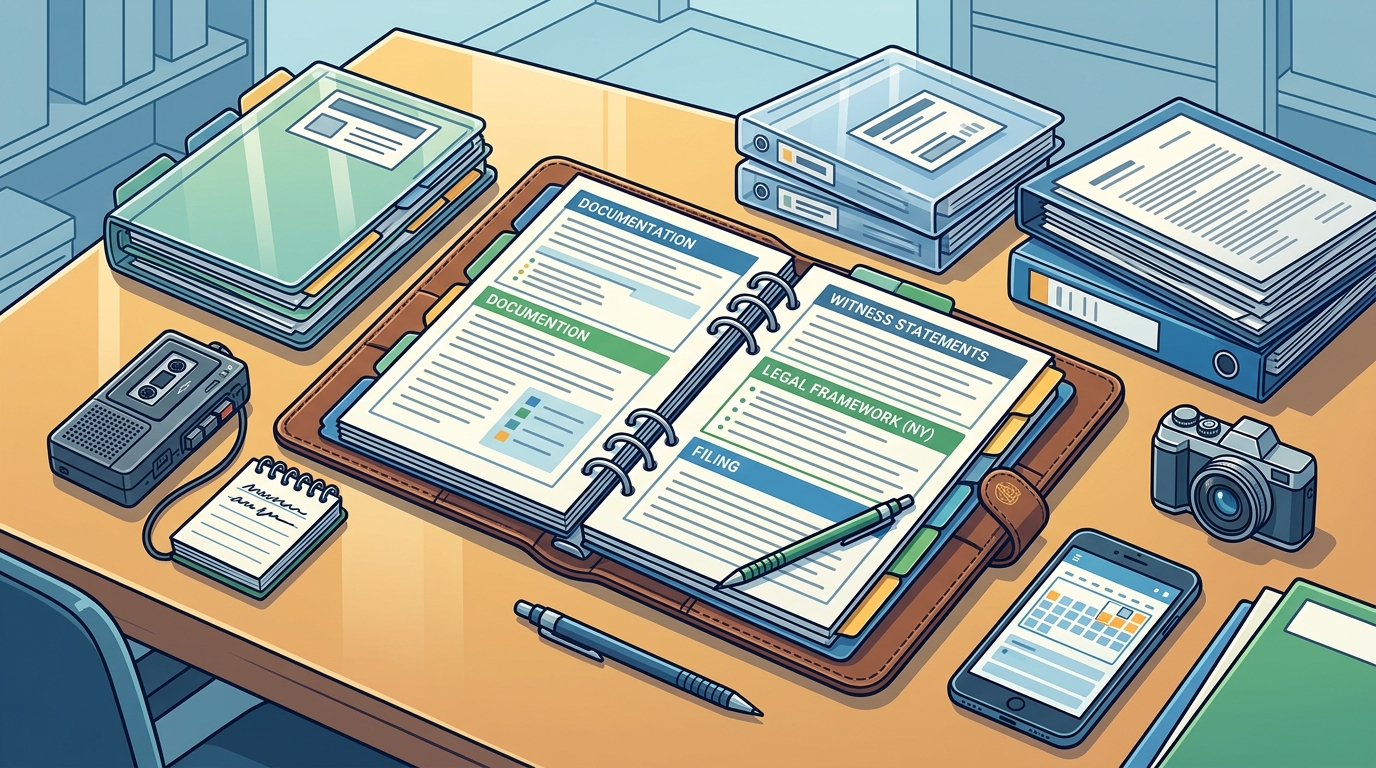
Documentation is the backbone of any hostile work environment claim. Courts rely heavily on contemporaneous evidence, and the absence of documentation weakens a claim significantly because memory fades and employers often dispute what occurred.
For each incident, record the following details as soon as possible after it occurs:
- Date and time of the incident
- Location (office, break room, email, video call, etc.)
- Exact words or actions used by the harasser
- Names of witnesses who were present
- Your emotional and professional response (did you leave the room? Lose focus on a project?)
Preserve all physical evidence—emails, text messages, photographs of offensive materials, screenshots of chat messages, and handwritten notes. In one notable federal court decision in the Southern District of New York, a plaintiff's detailed contemporaneous notes about repeated demeaning comments by a manager proved decisive in surviving summary judgment.
Step 4: Use Your Employer's Internal Complaint Process
Before pursuing external legal remedies, report the conduct through your employer's internal channels—typically a complaint to Human Resources or a designated compliance officer. This step serves two important purposes:
- It gives your employer the opportunity to investigate and correct the problem.
- It creates a paper trail showing the company was on notice of the hostile conditions.
This is especially important under federal law, where an employer can defend against a hostile work environment suit by showing it took reasonable care to prevent harassment and that the employee unreasonably failed to use available internal procedures.
Keep copies of every written complaint you submit and every response you receive. If your employer ignores the complaint or retaliates against you, that failure itself strengthens your legal position and may give rise to an additional retaliation claim. Under New York law, it is illegal for your employer to punish you or retaliate against you for making a complaint.
Step 5: Consult an Employment Discrimination Attorney
Hostile work environment cases demand specialized legal knowledge. An employment lawyer can:
- Evaluate whether your situation meets the legal threshold under federal, state, or city law
- Advise on the best venue for filing (EEOC, SDHR, NYC Commission on Human Rights, or court)
- Help you avoid mistakes—such as signing a severance agreement that waives your claims—before it is too late
- Identify overlapping claims such as retaliation, constructive discharge, or wage violations
Many employees, especially those in smaller or family-owned businesses, face extra pressure because the harasser may be the owner or a powerful executive. Consulting a lawyer before going to HR in these situations helps you develop a strategic plan for what to say, how to follow up, and how to respond if the company reacts negatively.
Step 6: File a Formal Complaint With the Appropriate Agency
If internal reporting fails to resolve the problem, the next step is filing an external complaint. In New York, you have several options:
| Agency | Jurisdiction | Key Deadline |
|---|---|---|
| EEOC (Equal Employment Opportunity Commission) | Federal – employers with 15+ employees | 300 days from the last incident |
| NYS Division of Human Rights (SDHR) | State – all employers in NY | 3 years for sexual harassment; 1 year for other claims |
| NYC Commission on Human Rights | New York City – all employers in the five boroughs | Up to 3 years |
You may also have the option to file directly in court under certain circumstances. An attorney can help you determine the best path based on your specific facts, employer size, and the type of damages you are seeking.
Step 7: Demonstrate Employer Liability
Proving the harassment occurred is only part of the equation. You must also show that your employer bears legal responsibility. Employer liability can be established in several ways:
- Direct involvement: A supervisor or manager committed the harassment.
- Constructive knowledge: The employer knew or should have known about the harassment.
- Failure to act: The employer failed to take prompt and appropriate action to remedy the hostile environment after being made aware of the conduct.
Under New York State law following the Zakrzewska v. New School ruling, companies bear strict liability for hostile environments created by supervisors—even without direct knowledge of the harassment. This is a powerful tool for employees whose complaints were ignored or buried.
Under the NYCHRL, employers can also be held liable for harassment by co-workers or even non-employees—such as customers or clients—if the employer failed to take corrective action.
Step 8: Prove the Impact on Your Employment
A successful claim must demonstrate that the hostile conduct meaningfully affected your ability to do your job. Evidence of impact can include:
- Declining performance reviews that coincide with the onset of harassment
- Medical records showing anxiety, depression, or stress-related conditions
- Records of missed work days
- Evidence of lost promotions, demotions, or reassignments
- Testimony from colleagues who observed changes in your demeanor or work output
Remember: you do not need to prove the conduct caused severe emotional distress under New York state standards. Courts have held that you only need to show the behavior altered the terms and conditions of employment in a meaningful way.
Key Differences: Federal vs. State vs. City Standards
| Element | Title VII (Federal) | NYSHRL (State) | NYCHRL (City) |
|---|---|---|---|
| Severity threshold | Severe or pervasive | More than petty slight/trivial inconvenience | Treated “less well” + more than petty slights |
| Employer size | 15+ employees | All employers | All employers (4+ for some provisions) |
| Who can be sued | Employer only | Employer, managers, co-workers, others | Employer, managers, co-workers, others |
| Filing deadline | 300 days (EEOC) | 1–3 years (SDHR) | Up to 3 years |
What Does Not Qualify as a Hostile Work Environment
Understanding the boundaries is just as important as knowing the elements. The following situations, on their own, generally do not meet the legal definition:
- A boss who is rude to everyone equally, with no connection to a protected characteristic
- Isolated minor comments or a single offhand remark (though one severe incident can qualify)
- Personality clashes or general office politics
- Legitimate performance criticism, even if it feels harsh
A boss who raises their voice at everyone or has a generally abrasive style may be unfair and unhealthy, but if the behavior is not connected to a protected characteristic, New York hostile work environment laws may not apply. The distinction between general workplace toxicity and legally actionable discrimination is one of the most important evaluations an attorney will make.
Types of Damages You Can Recover
If your hostile work environment claim is successful, you may be entitled to:
- Compensatory damages: Lost wages, medical expenses, therapy costs, and other out-of-pocket losses caused by the harassment
- Emotional distress damages: Compensation for psychological harm, anxiety, and diminished quality of life
- Punitive damages: Available under the NYCHRL and sometimes under Title VII, designed to punish the employer and deter future misconduct
- Attorney's fees and costs: The court may order the employer to pay your legal fees
Key Takeaways
- The conduct must be tied to a protected characteristic. General workplace bullying is not enough unless it targets a protected class.
- New York's standards are more employee-friendly than federal law. Under the NYSHRL, you do not need to prove harassment was “severe or pervasive”—only that it was more than a petty slight.
- Document everything immediately. Contemporaneous notes, saved emails, and witness names are often the difference between winning and losing.
- Use internal complaint procedures first. Failing to report internally can undermine your case, especially under federal law.
- File within the deadline. Statutes of limitation range from 300 days (EEOC) to three years (SDHR/NYC Commission), depending on the law and type of claim.
- An attorney can identify all overlapping claims. Retaliation, constructive discharge, and wage violations frequently accompany hostile work environment cases.
Frequently Asked Questions
Does harassment need to be severe or pervasive to be illegal in New York?
Under the NYSHRL, no. Since 2019 amendments took effect, the law prohibits harassment that subjects an employee to inferior terms, conditions, or privileges of employment—the conduct only needs to be more than a petty slight or trivial inconvenience. The NYCHRL is even broader, requiring only proof that you were treated “less well” because of a protected characteristic.
Can a single incident create a hostile work environment in New York?
Yes. An unwanted sexual touching, a physical assault, or an explicit threat targeting your race, religion, or sexual orientation can be severe enough on its own. You do not need to wait for repeated behavior before your rights are triggered.
What is the statute of limitations for a hostile work environment claim in New York?
The deadline depends on where you file. Title VII federal claims must be filed with the EEOC within 300 days. The NYS Division of Human Rights allows three years for sexual harassment claims and one year for other forms of harassment. NYC Human Rights Law claims may be filed within three years.
Can I sue for a hostile work environment if I already quit my job?
Yes. If the workplace conditions were so intolerable that a reasonable person would have felt forced to resign, this may constitute constructive discharge. You can still pursue damages including lost wages and emotional distress.
Who can be held liable for a hostile work environment in New York?
Under the NYSHRL, an employee can sue anyone responsible for creating a hostile work environment—employer, manager, co-worker, or even a non-employee like a client. Federal claims under Title VII are typically brought against the employer only.
Do I need to report harassment to HR before filing a lawsuit?
While not always legally required under state and city law, using internal procedures first is strongly recommended. Under Title VII, an employer can raise as a defense that you failed to take advantage of available internal complaint mechanisms. Internal reports also create critical evidence that the employer was on notice.
Disclaimer: This article is for informational purposes only and does not constitute legal advice. Every hostile work environment case depends on its unique facts. If you believe your workplace has become hostile, consult a qualified New York employment discrimination attorney to evaluate your specific situation and protect your rights.