

Understanding the legal landscape for workplace harassment requires navigating a complex web of overlapping regulations. For employees in New York, the distinction between federal protections and local city ordinances is not merely academic. It determines the scope of protected classes, the threshold for proving harassment, and the remedies available. Recent legal shifts have significantly expanded employee rights under local statutes, creating a more robust safety net than federal law alone provides. This guide breaks down the critical differences to help you understand your position.
Defining the Hostile Work Environment
A hostile work environment is a form of harassment where unwelcome conduct based on a protected characteristic is so severe or pervasive that it alters the conditions of employment. This conduct creates an intimidating, offensive, or abusive working environment. Under both federal and New York City laws, the conduct must be objectively offensive and subjectively perceived as such by the victim. However, the definition of what constitutes "unwelcome conduct" varies significantly between the two frameworks.
Hostile work environment harassment is not limited to physical contact. It includes verbal abuse, offensive jokes, slurs, intimidation, ridicule, and the display of offensive materials. The key differentiator in NYC law is the breadth of what is considered offensive and the lower bar for proving that the environment was hostile. Federal law requires a higher burden of proof, often demanding evidence of tangible job detriment or extreme severity. In contrast, NYC law focuses on the impact of the conduct on the individual employee, regardless of whether it rose to the level of causing psychological injury.
Scope of Protected Classes
The most significant difference lies in who is protected. Federal laws, such as Title VII of the Civil Rights Act of 1964, protect employees from discrimination based on race, color, religion, sex, and national origin. The Age Discrimination in Employment Act (ADEA) adds age (40 and older) to this list. While these protections are foundational, they leave many workers without recourse under federal statutes alone.
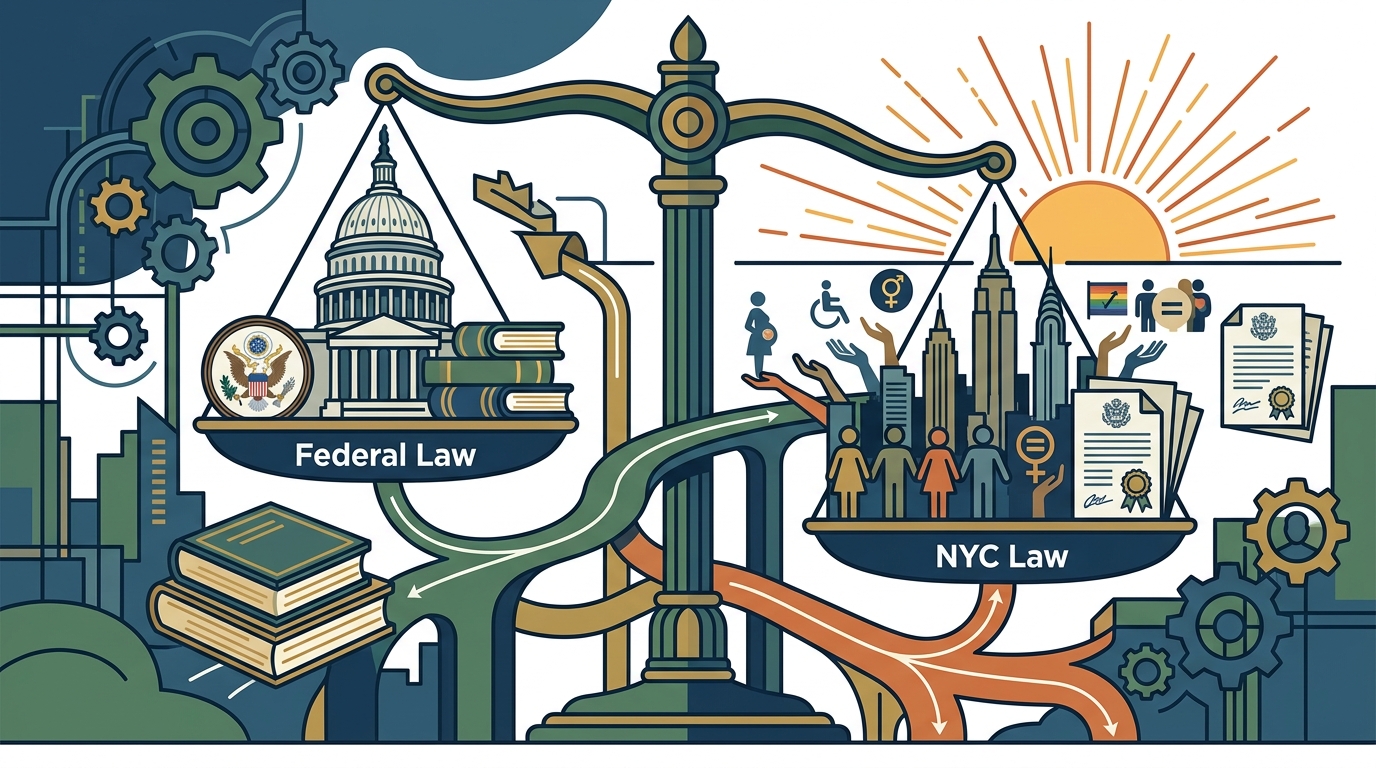
New York City Human Rights Law (NYCHRL) expands this list dramatically. It protects individuals based on race, creed, color, national origin, citizenship status, age, disability, gender, gender identity or expression, sexual orientation, marital status, partnership status, family status, pregnancy, domestic violence victim status, criminal conviction history, and genetic characteristics. This expansive list ensures that workers facing discrimination for reasons unrelated to federal protected classes still have legal standing in NYC. For more details on specific discrimination types, visit our employment discrimination practice area.
This broader scope means that an employee harassed based on their sexual orientation, gender identity, or even their status as a domestic violence survivor may not have a viable federal claim but has a strong claim under NYC law. The inclusion of "gender identity or expression" as a distinct protected class in NYC law addresses modern workplace dynamics that federal interpretations have been slower to adopt. According to recent legal analyses, the expansion of protected classes under local laws has led to a significant increase in successful harassment claims in New York courts. EEOC guidelines emphasize the importance of understanding these local variations.
Legal Thresholds: Severity vs. Pervasiveness
Proving a hostile work environment under federal law requires demonstrating that the harassment was both severe and pervasive. This is a high bar. Courts often look for a pattern of conduct that is extreme enough to alter the conditions of the victim's employment. Isolated incidents, unless extremely serious, are rarely sufficient to meet this standard. For example, a single instance of physical assault might be enough, but a series of offensive jokes might not be considered severe enough under federal precedent.
NYCHRL applies a much more plaintiff-friendly standard. It does not require the conduct to be severe or pervasive in the same way federal law does. Instead, the law asks whether the harassment would reasonably be perceived as hostile or abusive. This objective standard considers the totality of the circumstances from the perspective of a reasonable victim in the same situation. The focus is on the impact of the conduct rather than its frequency or intensity alone. This lower threshold makes it easier for employees to bring claims under NYC law.
The difference in thresholds is critical. Under federal law, a single severe incident might be required to prove a claim if the incidents are not pervasive. Under NYC law, a series of less severe incidents can collectively create a hostile environment. This distinction is vital for employees experiencing ongoing microaggressions or subtle forms of harassment that do not rise to the level of federal severity. Phillips & Associates frequently handles cases where federal claims fail but NYC claims succeed due to this difference. Learn more about our age discrimination lawyer services for insights into how age-related harassment is treated differently.
Employer Liability Standards
Liability for supervisors' actions also differs. Under federal law, if a supervisor's harassment culminates in a tangible employment action (like firing or demotion), the employer is strictly liable. If no tangible action occurs, the employer can avoid liability by proving it exercised reasonable care to prevent and correct harassment and that the employee unreasonably failed to use provided complaints procedures.
NYCHRL imposes stricter liability on employers. Employers are automatically liable for the actions of supervisors unless they can prove they took reasonable care to prevent harassment and that the employee unreasonably failed to take advantage of preventive opportunities. However, the burden of proof and the definition of "reasonable care" are interpreted more broadly under NYC law. Employers must have robust, accessible, and effective anti-harassment policies in place. Simply having a policy is not enough; it must be actively enforced. For information on our approach to workplace harassment, see our workplace harassment resources.
This stricter standard holds employers accountable for fostering a safe workplace. It encourages proactive measures rather than reactive defenses. Employers in NYC must ensure that their complaint mechanisms are truly accessible and that retaliation for complaints is strictly prohibited. The law recognizes that power dynamics in the workplace can inhibit reporting, so it places a heavier burden on the employer to demonstrate that they have mitigated these barriers.
Remedies and Legal Process
The remedies available under NYC law are often more comprehensive than those under federal law. Federal law caps compensatory and punitive damages based on the size of the employer. NYC law does not have these caps, allowing for potentially higher awards for emotional distress and other harms. Additionally, NYC law allows for the recovery of attorney's fees and costs, which can be significant in prolonged litigation.
The process for filing a claim also differs. Under federal law, you must typically file a charge with the EEOC within 180 or 300 days, depending on the state. In New York, you can file with the NYC Commission on Human Rights (CCHR) or directly in court. The CCHR offers a free administrative process that can lead to mediation or a hearing. This administrative route can be faster and less costly than federal litigation. However, time limits are strict, and missing a deadline can bar your claim entirely. For urgent matters, contact our office immediately.
Comparing the two frameworks highlights the strategic advantages of pursuing claims under NYC law when applicable. The broader protections, lower thresholds, and uncapped damages make it a powerful tool for victims of harassment. However, the complexity of navigating both systems requires experienced legal counsel. Our firm has a proven track record in sexual harassment cases, leveraging these legal distinctions to secure justice for our clients.
Key Takeaways
- Protected Classes: NYC law protects significantly more categories, including gender identity, sexual orientation, and criminal history, than federal law.
- Threshold for Proof: NYC law does not require harassment to be "severe and pervasive" to the same extent as federal law, focusing instead on whether a reasonable person would find it hostile.
- Employer Liability: Employers face stricter liability under NYC law for supervisor misconduct and must demonstrate proactive prevention efforts.
- Remedies: NYC law does not cap damages, offering potentially higher compensation for emotional distress and punitive damages compared to federal caps.
- Legal Process: Victims can utilize the NYC Commission on Human Rights for free administrative relief, offering an alternative to federal EEOC processes.
- Statute of Limitations: Deadlines for filing vary between federal and local agencies, making timely legal consultation critical.
- Attorney Fees: NYC law allows for the recovery of attorney's fees, reducing the financial burden on plaintiffs.
Frequently Asked Questions
Can I file a federal and NYC claim simultaneously?
Yes, you can file charges with both the EEOC and the NYC Commission on Human Rights. However, there are work-sharing agreements that may streamline the process. It is important to coordinate these filings to avoid procedural pitfalls.
Does NYC law cover harassment by non-supervisors?
Yes, NYC law holds employers liable for harassment by co-workers, clients, or customers if the employer knew or should have known about the conduct and failed to take appropriate action.
What is the statute of limitations for NYC harassment claims?
You generally have three years from the date of the discriminatory act to file a lawsuit in court under the NYCHRL. Administrative complaints with the CCHR have different deadlines, so prompt action is essential.
How does NYC law define "gender identity"?
Gender identity is defined as a person's self-identified gender, which may be different from their sex assigned at birth. This includes transgender, non-binary, and gender non-conforming individuals.
Are there caps on damages under NYC law?
No, unlike federal law, the NYCHRL does not impose caps on compensatory or punitive damages. This allows for full compensation for the harm suffered.
What constitutes a "tangible employment action"?
A tangible employment action involves a significant change in employment status, such as hiring, firing, failing to promote, reassignment with significantly different responsibilities, or a decision causing a significant change in benefits.
Can I be retaliated against for filing a complaint?
No, both federal and NYC laws prohibit retaliation against employees who file complaints or participate in investigations. Retaliation itself is a separate violation of the law.
Contact Phillips & Associates
If you are experiencing a hostile work environment in New York City, do not wait. The differences between federal and NYC law can significantly impact the outcome of your case. Our experienced attorneys are ready to help you navigate these complexities and fight for your rights. Contact us today to schedule a free consultation and discuss your options. Visit our contact page to get started.