

Understanding the legal landscape for workplace harassment requires navigating a complex web of overlapping regulations. For employees in New York, the distinction between federal protections and local city ordinances is not merely academic; it determines the scope of your rights and the severity of penalties an employer faces. Recent data indicates that workplace harassment claims have surged, with many individuals seeking clarity on which jurisdiction offers stronger protections. According to the Equal Employment Opportunity Commission, the number of harassment charges filed has remained consistently high over the last decade, highlighting the critical need for precise legal knowledge. This guide breaks down the specific differences that matter most to your case. (New York Employment Discrimination)
Defining the Hostile Work Environment
Before comparing jurisdictions, it is essential to establish a clear legal baseline. A hostile work environment is not simply a difficult or unpleasant workplace. It is a specific legal concept defined by the frequency and severity of the conduct. Hostile work environment is a form of harassment where unwelcome conduct based on a protected characteristic is so severe or pervasive that it alters the conditions of the victim's employment. (New York Employment Discrimination)
This definition applies across both federal and local laws, but the application differs significantly. The conduct must be objectively offensive and subjectively perceived as hostile by the victim. Examples include persistent sexual advances, racial slurs, or physical intimidation. However, not every instance of offensive behavior qualifies. The law requires a pattern of behavior or a single incident of extreme severity to meet the legal threshold. Understanding this baseline is the first step in evaluating your rights under NYC law versus federal law.
Federal Law Standards and Limitations
Federal law, primarily Title VII of the Civil Rights Act of 1964, sets the minimum floor for workplace protections. Under federal standards, proving a hostile work environment is notoriously difficult. The Supreme Court has established that the harassment must be both severe and pervasive. This means that isolated incidents, unless extremely serious, are generally insufficient to support a claim.
For example, a single offensive joke or a one-time inappropriate comment typically does not meet the federal threshold. The plaintiff must demonstrate a pattern of conduct that creates an abusive working condition. This high bar often leaves victims of chronic but less "extreme" harassment without recourse under federal law alone. Furthermore, federal law applies only to employers with a minimum number of employees, usually 15 or more. This limitation excludes many smaller workplaces from federal protection.
Additionally, federal law imposes strict procedural hurdles. Victims must file a charge with the Equal Employment Opportunity Commission (EEOC) before pursuing a lawsuit. The EEOC process can be lengthy, and the agency may decline to issue a right-to-sue letter, forcing the victim to navigate a complex administrative landscape. These limitations make federal law a less robust tool for many New York workers.
NYC Human Rights Law Advantages
New York City Human Rights Law (NYCHRL) offers significantly broader protections than federal law. The NYCHRL was amended to be the most protective anti-discrimination law in the United States. Its primary advantage lies in its lower threshold for proving a hostile work environment. Under the NYCHRL, conduct does not need to be severe or pervasive to be unlawful. Instead, the law asks whether the harassment is "sufficiently severe or pervasive" to interfere with the victim's work performance or create an intimidating, hostile, or offensive environment.
This standard is more plaintiff-friendly. It allows for a broader range of behaviors to be considered actionable. For instance, a series of comments that might be dismissed under federal law could easily meet the NYCHRL standard. The law also protects a wider array of characteristics, including gender identity, sexual orientation, and even arrest records. This expansive scope ensures that more workers are covered under the law.
Another critical advantage is the employer liability standard. Under federal law, employers can sometimes avoid liability for harassment by non-supervisors if they can prove they took reasonable care to prevent and correct the behavior. Under the NYCHRL, employers are held to a stricter standard. They can be held liable for the actions of their employees, supervisors, and even non-employees if they knew or should have known about the harassment and failed to take appropriate action. This makes it easier for victims to hold companies accountable.
Key Differences in Legal Thresholds
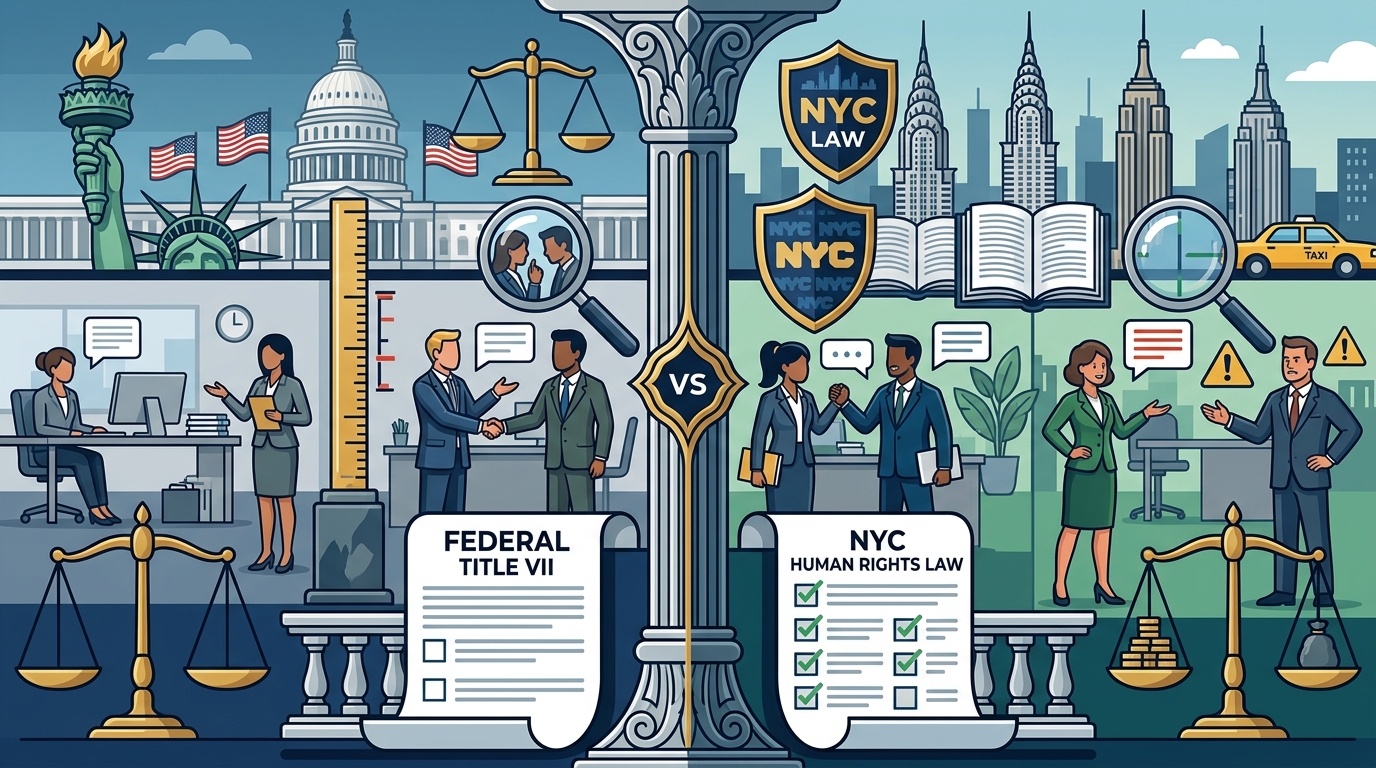
The divergence between federal and NYC law is stark when examining specific legal tests. The following table summarizes the core differences that impact your case strategy.
| Legal Factor | Federal Law (Title VII) | NYC Human Rights Law (NYCHRL) |
|---|---|---|
| Severity Threshold | Must be "severe or pervasive" | Must be "sufficiently severe or pervasive" (lower bar) |
| Protected Classes | Race, color, religion, sex, national origin | Includes gender identity, sexual orientation, arrest records, and more |
| Employer Size | Minimum 15 employees | No minimum employee threshold |
| Statute of Limitations | 300 days for EEOC charge | 3 years for civil rights claims |
| Damages | Capped based on employer size | No caps on compensatory or punitive damages |
This comparison highlights why filing under the NYCHRL is often the superior strategy. The lower threshold means that more cases can proceed to litigation. The absence of a cap on damages also provides greater potential compensation for victims. Phillips & Associates frequently leverages these differences to maximize recovery for our clients. We analyze each case to determine the strongest legal pathway, often pursuing both federal and state claims simultaneously.
Statutes of Limitations and Deadlines
Time is a critical factor in any discrimination claim. Federal law requires victims to file a charge with the EEOC within 300 days of the alleged harassment. This deadline is strict and non-negotiable in most cases. Missing this window can result in the permanent loss of your right to sue under federal law.
In contrast, the NYCHRL provides a longer statute of limitations. Victims have three years from the date of the discriminatory act to file a civil rights claim in court. This extended timeframe allows for more thorough investigation and preparation. However, it is crucial to note that administrative exhaustion requirements may still apply. In many cases, you must file with the NYC Commission on Human Rights (CCHR) before proceeding to court.
Understanding these deadlines is vital. A delay in reporting harassment can complicate your case. Evidence may be lost, and witnesses may become unavailable. Phillips & Associates advises clients to act promptly. We help navigate the complex filing processes for both the EEOC and the CCHR to ensure all procedural requirements are met. Our team ensures that no deadline is missed, preserving your right to seek justice.
Potential Damages and Remedies
The financial consequences for employers differ significantly between the two legal frameworks. Under federal law, compensatory and punitive damages are capped based on the size of the employer. For companies with more than 500 employees, the cap is $300,000. This limit can be insufficient to cover the full extent of a victim's losses, including emotional distress and lost wages.
Under the NYCHRL, there are no caps on compensatory or punitive damages. This means that victims can recover the full amount of their proven losses, including significant sums for emotional distress. Punitive damages are also available if the employer acted with malice or reckless indifference. This lack of a cap provides a stronger incentive for employers to comply with the law and a greater potential recovery for victims.
Additionally, the NYCHRL allows for the recovery of attorney's fees and costs. This provision encourages victims to pursue their claims without the fear of bearing the full financial burden of litigation. Federal law also allows for fee-shifting, but the broader damages available under the NYCHRL make it a more attractive option for many plaintiffs. We work to ensure that our clients receive full compensation for the harm they have suffered.
Frequently Asked Questions
Can I sue my employer under both federal and NYC law?
Yes, it is common to file claims under both federal and local laws. This strategy allows you to take advantage of the broader protections and higher damages available under the NYCHRL while preserving your federal rights. Our attorneys at Phillips & Associates routinely pursue dual claims to maximize your recovery.
Does NYC law cover harassment by non-supervisors?
Yes, the NYCHRL holds employers liable for harassment by co-workers and non-employees if the employer knew or should have known about the conduct and failed to take action. This is a broader standard than federal law, which often requires a higher level of employer negligence.
What is the deadline to file a complaint in NYC?
You have three years from the date of the harassment to file a civil rights claim under the NYCHRL. However, administrative charges with the CCHR may have shorter deadlines. It is essential to consult with an attorney immediately to ensure all deadlines are met.
Are there caps on damages under NYC law?
No, there are no statutory caps on compensatory or punitive damages under the NYCHRL. This allows victims to recover the full extent of their losses, including emotional distress, which is often significant in hostile work environment cases.
What constitutes a "severe or pervasive" environment under NYC law?
Under the NYCHRL, the standard is whether the harassment is "sufficiently severe or pervasive" to interfere with work or create an offensive environment. This is a lower threshold than the federal "severe or pervasive" standard, making it easier to prove a claim.
Does the NYCHRL protect against sexual orientation discrimination?
Yes, the NYCHRL explicitly protects individuals from discrimination based on sexual orientation and gender identity. These protections are broader than federal law in some respects, as they are clearly codified in local ordinance.
How does the NYCHRL handle employer liability?
The NYCHRL imposes strict liability on employers for harassment by supervisors in many cases. For non-supervisors, employers are liable if they knew or should have known about the harassment and failed to take appropriate corrective action.
Contact Phillips & Associates
If you are experiencing a hostile work environment in New York City, do not wait to seek legal advice. The differences between federal and NYC law can significantly impact the outcome of your case. Phillips & Associates is dedicated to fighting for the rights of employees against large employers. We provide aggressive representation and strategic counsel to help you navigate the complexities of discrimination law.
Contact us today to schedule a free consultation. Our team of experienced employment discrimination lawyers is ready to evaluate your case and develop a robust legal strategy. Visit our Contact Us page to get started. You can also learn more about our practice areas on our Blog or review our Age Discrimination Lawyer resources for additional insights. We serve clients in New York City, Long Island, White Plains, Philadelphia, Princeton, and Miami. Call us at 866-229-9441 to discuss your rights.