

Understanding the legal landscape for workplace harassment requires navigating a complex web of overlapping regulations. A hostile work environment is defined as severe or pervasive harassment that creates an intimidating, offensive, or abusive atmosphere for an employee. While federal laws set a baseline, local ordinances often provide significantly broader protections. Recent data indicates that employment discrimination claims in New York City have surged, with the New York City Commission on Human Rights receiving thousands of complaints annually regarding workplace harassment. This surge highlights the critical need for employees to understand the specific jurisdictional advantages available to them. (New York Employment Discrimination)
Defining the Legal Framework
The primary distinction between federal and New York City law lies in the threshold for what constitutes a violation. Under federal statutes, specifically Title VII of the Civil Rights Act of 1964, a hostile work environment must be both severe and pervasive. This is a high bar. Courts often dismiss cases where the harassment, while offensive, does not meet this strict dual requirement. The behavior must be objectively offensive to a reasonable person and subjectively offensive to the victim.
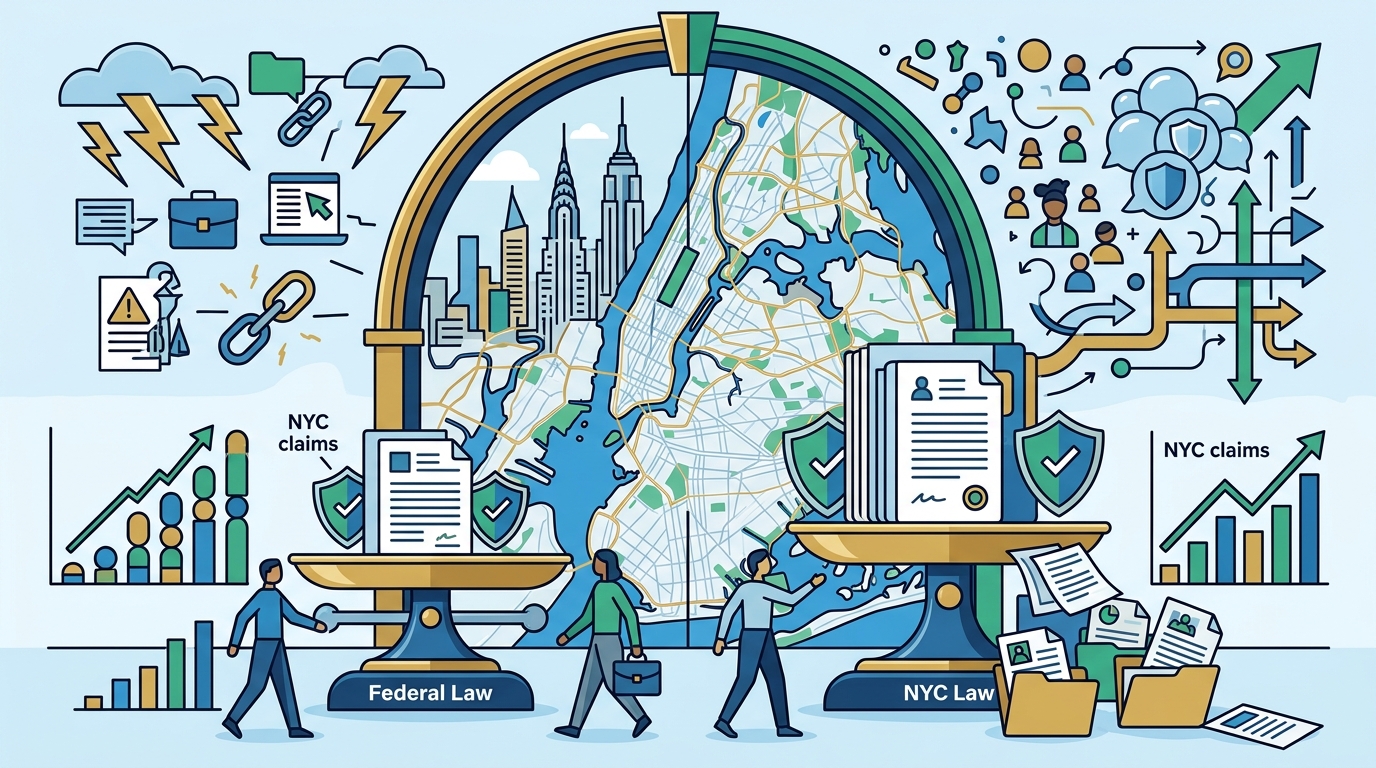
In contrast, the New York City Human Rights Law (NYCHRL) adopts a much more plaintiff-friendly standard. The NYCHRL explicitly states that the standards used in federal law are insufficient to protect the rights of people in New York City. Under the NYCHRL, harassment need only be "severe or pervasive" rather than "severe and pervasive." This single word change, "or" instead of "and," dramatically expands the scope of actionable conduct. It means that a single incident of severe harassment, or a series of less severe incidents, can potentially constitute a violation under city law.
Phillips & Associates frequently advises clients that the NYCHRL provides a broader net for justice. The law is designed to be interpreted in the most protective manner possible for individuals. This means that behaviors which might be dismissed in federal court are often viable claims under NYC law. Understanding this distinction is vital for anyone seeking legal recourse.
The Severity and Pervasiveness Test
When evaluating a potential claim, the context of the workplace is crucial. Federal courts look at the totality of the circumstances, including the frequency of the conduct, its severity, whether it is physically threatening or humiliating, and whether it unreasonably interferes with work performance. However, this analysis is often rigid and favors the employer.
New York City law requires a more flexible analysis. The NYCHRL mandates that the perspective of a reasonable victim of the protected class be considered. This means the court must look at the situation through the eyes of someone who shares the victim's characteristics. For example, a comment that might be considered a minor slight by one group could be deeply offensive and pervasive to another.
Furthermore, the NYCHRL explicitly prohibits harassment based on the perception of a protected characteristic, even if the perception is incorrect. This is a significant departure from some federal interpretations that require the characteristic to be real. If an employer harasses an employee because they believe the employee is gay, even if the employee is not, this is a violation under NYC law. This protection ensures that bias-driven harassment is addressed regardless of the employee's actual identity.
Protected Classes and Scope
The range of protected classes is another major differentiator. Federal law protects individuals based on race, color, religion, sex, and national origin. While these are fundamental protections, they do not cover many other forms of discrimination that occur in the modern workplace.
The NYCHRL expands this list significantly. It includes protections for age, disability, marital status, veteran status, criminal conviction history, and gender identity or expression. It also protects against discrimination based on sexual orientation, which was not explicitly covered under federal law until the Supreme Court's decision in Bostock v. Clayton County in 2020. Even then, the NYCHRL had covered sexual orientation discrimination for years prior.
This expanded scope means that employees who might have no recourse under federal law have clear protections under NYC law. For instance, discrimination based on a person's height, weight, or hair texture is explicitly prohibited in New York City. This is particularly relevant for Black employees who face discrimination based on natural hair textures or protective hairstyles. The NYCHRL's breadth ensures that a wider array of workplace abuses can be challenged legally.
Employer Liability Standards
How an employer is held responsible for the actions of its employees also differs between the two legal systems. Under federal law, an employer's liability for harassment by supervisors is determined by specific guidelines. If the harassment results in a tangible employment action, such as firing or demotion, the employer is strictly liable. If no tangible action occurs, the employer can raise an affirmative defense by showing it exercised reasonable care to prevent and correct harassment and that the employee unreasonably failed to use provided complaint mechanisms.
New York City law imposes a stricter standard on employers. The NYCHRL states that employers are automatically liable for the unlawful harassment of their employees by supervisors, agents, or other employees. There is no affirmative defense available to employers under the NYCHRL for supervisor harassment. This means that if a supervisor creates a hostile work environment, the company is responsible, regardless of whether they had a policy against harassment or whether the victim reported it.
This automatic liability creates a powerful incentive for employers to maintain robust compliance programs. It also provides victims with a clearer path to recovery. Victims do not need to prove that the employer was negligent in preventing the harassment. The mere fact that the harassment occurred by a company agent is sufficient to establish liability. This is a significant advantage for plaintiffs in NYC.
Procedural Hurdles and Deadlines
Filing a claim involves different procedural steps depending on the jurisdiction. For federal claims, victims generally must file a charge with the Equal Employment Opportunity Commission (EEOC) within 180 days of the alleged harassment. In some cases, this deadline is extended to 300 days if there is a state or local agency involved. After the EEOC process, the victim may receive a right-to-sue letter, allowing them to file a lawsuit in federal court.
Under NYC law, victims must file a complaint with the New York City Commission on Human Rights (CCHR) within one year of the alleged discrimination. Alternatively, they can file a lawsuit directly in state or federal court. However, if they choose to file with the CCHR, they must do so within that one-year window. The CCHR has the power to investigate, mediate, and issue cease-and-desist orders. This administrative process can be faster and less costly than litigation.
It is crucial to note that the deadlines are strict. Missing the EEOC deadline can bar a federal claim entirely. Similarly, missing the CCHR deadline can bar a city claim. Phillips & Associates emphasizes the importance of acting quickly. Early legal intervention ensures that evidence is preserved and that all procedural requirements are met. Do not wait to seek help. The longer you wait, the more difficult it becomes to build a strong case.
Key Takeaways
- Threshold Difference: NYC law requires harassment to be "severe or pervasive," while federal law requires "severe and pervasive." This makes it easier to prove a claim in NYC.
- Protected Classes: The NYCHRL covers more categories, including age, disability, marital status, and gender identity, offering broader protection than federal law.
- Employer Liability: Employers in NYC are automatically liable for supervisor harassment, with no affirmative defense available, unlike under federal law.
- Perception Protection: NYC law protects individuals from harassment based on the perception of a protected characteristic, even if the perception is incorrect.
- Deadlines: Federal claims typically have an 180-day filing deadline with the EEOC, while NYC claims have a one-year deadline with the CCHR or for direct filing.
- Legal Representation: Navigating these complex laws requires experienced counsel. Phillips & Associates specializes in these distinctions to maximize client outcomes.
- Impact: Understanding these differences is critical for determining the best legal strategy for victims of workplace harassment in New York City.
Frequently Asked Questions
What is the main difference between federal and NYC hostile work environment laws?
The main difference is the standard for severity. Federal law requires harassment to be both "severe and pervasive," while NYC law requires it to be "severe or pervasive." This makes it easier to win a case under NYC law.
Does NYC law protect against harassment based on gender identity?
Yes. The New York City Human Rights Law explicitly protects individuals from discrimination and harassment based on gender identity and expression. This protection exists independently of federal law.
How long do I have to file a complaint in New York City?
You generally have one year from the date of the alleged discrimination to file a complaint with the New York City Commission on Human Rights or to file a lawsuit in court. Federal deadlines are often shorter.
Can my employer be held liable for a supervisor's harassment?
Under NYC law, employers are automatically liable for harassment by supervisors. They cannot use the defense that they had policies against harassment or that the victim did not report it.
What is a hostile work environment?
A hostile work environment is a form of harassment that is severe or pervasive enough to create an intimidating, hostile, or offensive work environment. It unreasonably interferes with an individual's work performance.
Does NYC law cover discrimination based on criminal history?
Yes. The NYCHRL prohibits employers from discriminating against applicants and employees based on their criminal conviction history, with limited exceptions for specific roles.
Why is it important to hire a local lawyer?
Local lawyers understand the nuances of the NYCHRL and the specific practices of the CCHR and local courts. They can identify claims that might be missed under a purely federal analysis.
Contact Phillips & Associates
If you are experiencing harassment at work, do not suffer in silence. The legal landscape in New York City offers robust protections that are often overlooked. Phillips & Associates is dedicated to fighting for the rights of employees against large employers. We have a proven track record of success in handling complex discrimination and harassment cases.
Our team understands the intricacies of both federal and local laws. We can help you determine the best course of action and ensure your rights are protected. Contact us today for a free consultation. Visit our Contact Us page to schedule a meeting. You can also learn more about our practice areas on our home page.
We serve clients in New York City, Long Island, White Plains, Philadelphia, Princeton, and Miami. Our age discrimination and Bergen County employment resources provide additional insights into your rights. Do not wait until it is too late. Take the first step toward justice today.