

Should I Hire a Lawyer Before Filing an EEOC Charge for Racial Discrimination in New York?
Racial discrimination in the workplace remains a persistent challenge for professionals across New York, with data showing that employment discrimination claims continue to rise annually in both federal and state courts. According to the U.S. Equal Employment Opportunity Commission, racial discrimination charges have consistently accounted for a significant percentage of all filings, highlighting the widespread nature of this issue. Navigating the complex intersection of federal mandates and New York State Human Rights Law requires precise legal strategy. This guide outlines why securing counsel before initiating the administrative process is critical for protecting your rights and maximizing potential recovery.
Why Legal Counsel Matters Before Filing
The decision to file a charge with the Equal Employment Opportunity Commission (EEOC) is not merely a procedural step. It is the foundational act of a legal claim that will determine the scope of your investigation and the strength of your eventual argument. Race discrimination is defined as treating an applicant or employee unfavorably because of their personal characteristics associated with race, such as skin pigmentation, hair texture, or cultural features.
Many individuals believe they can navigate this process alone. However, the EEOC process is rigid. Missing a deadline or failing to articulate the specific legal theory of discrimination can result in the dismissal of your claim before it ever reaches a court. Phillips & Associates specializes in high-stakes employment discrimination cases, including race discrimination and other protected class violations. Their attorneys understand that the pre-filing phase is where the case is won or lost.
Early intervention allows your attorney to preserve evidence that might otherwise be destroyed. Employers often change policies, delete emails, or restructure teams immediately after a complaint is anticipated. A lawyer can issue litigation holds and secure witness statements before the employer has time to react.
Understanding the EEOC Filing Process
The EEOC is the federal agency responsible for enforcing laws that make it illegal to discriminate against a job applicant or an employee because of the person's race, color, religion, sex, national origin, age, disability, or genetic information. The process begins with the filing of a Charge of Discrimination.
Once a charge is filed, the EEOC will notify your employer. The agency may then choose to investigate the claim, mediate the dispute, or dismiss the charge. If the EEOC finds reasonable cause to believe discrimination occurred, they will attempt to resolve the matter through conciliation. If conciliation fails, the EEOC may file a lawsuit on your behalf or issue a Right to Sue notice, allowing you to file a private lawsuit.
However, the timeline and procedural requirements vary significantly depending on whether you file in New York State or federally. In New York, you may have the option to file with the New York State Division of Human Rights (DHR) or the New York City Commission on Human Rights (CCHR), depending on your location. Each agency has different deadlines and procedural rules. For instance, the deadline to file a charge with the EEOC in New York is typically 300 days from the date of the alleged discriminatory act, which is longer than the standard 180-day federal deadline.
Understanding these nuances is vital. A lawyer can help you determine the most advantageous agency to file with, ensuring that your rights are preserved under both state and federal laws. This strategic choice can significantly impact the outcome of your case.
New York State Protections vs. Federal Law
New York State and New York City offer robust protections against racial discrimination that often exceed federal standards. The New York State Human Rights Law (NYSHRL) and the New York City Human Rights Law (NYCHRL) are known for their broad scope and strong enforcement mechanisms.
One key difference is the standard of proof. Under federal law, plaintiffs must often meet a higher burden to prove discrimination. In contrast, the NYCHRL requires only that race be a "motivating factor" in the adverse employment action, regardless of whether the employer had legitimate, nondiscriminatory reasons for its actions. This lower threshold can make it easier to succeed in state or local claims.
Additionally, New York law provides for broader damages, including punitive damages and attorney's fees, which are not always available under federal statutes. The NYSHRL was recently amended to expand protections for employees, making it more favorable for plaintiffs in discrimination cases. Phillips & Associates, with offices in New York City, Long Island, and White Plains, is well-positioned to leverage these state-specific advantages.
Furthermore, New York City has its own commission, the CCHR, which handles discrimination complaints within the five boroughs. Filing with the CCHR can sometimes lead to faster resolutions and more localized remedies. An experienced attorney can guide you through the parallel filing processes, ensuring that you do not waive any rights by filing with one agency over another.
Strategic Advantages of Early Representation
Hiring a lawyer before filing an EEOC charge provides several strategic advantages that can significantly impact the outcome of your case. First, an attorney can help you draft a more compelling charge. The EEOC investigator will rely heavily on the initial charge to determine the scope of their investigation. A well-drafted charge can lead to a more thorough investigation and a stronger finding of reasonable cause.
Second, early representation allows for proactive evidence gathering. As mentioned earlier, evidence can be lost or destroyed quickly. An attorney can send preservation letters to your employer, ensuring that relevant documents, emails, and personnel files are kept intact. This is crucial for proving the pattern of discrimination or the specific intent behind the adverse action.
Third, an attorney can help you navigate the mediation process. The EEOC often offers mediation as a voluntary process to resolve the dispute. Having a lawyer present during mediation can ensure that your interests are protected and that any settlement agreement is fair and comprehensive. Without legal counsel, you may accept a settlement that waives your right to pursue further legal action or fails to compensate you adequately for your losses.
Finally, early representation signals to your employer that you are serious about pursuing your claim. This can sometimes lead to a more favorable settlement offer, as employers may prefer to resolve the matter quickly rather than face a costly and protracted legal battle. Phillips & Associates has a track record of achieving favorable outcomes for clients in Princeton, Bergen County, and Burlington County by leveraging this strategic positioning.
Risks of Filing Without a Lawyer
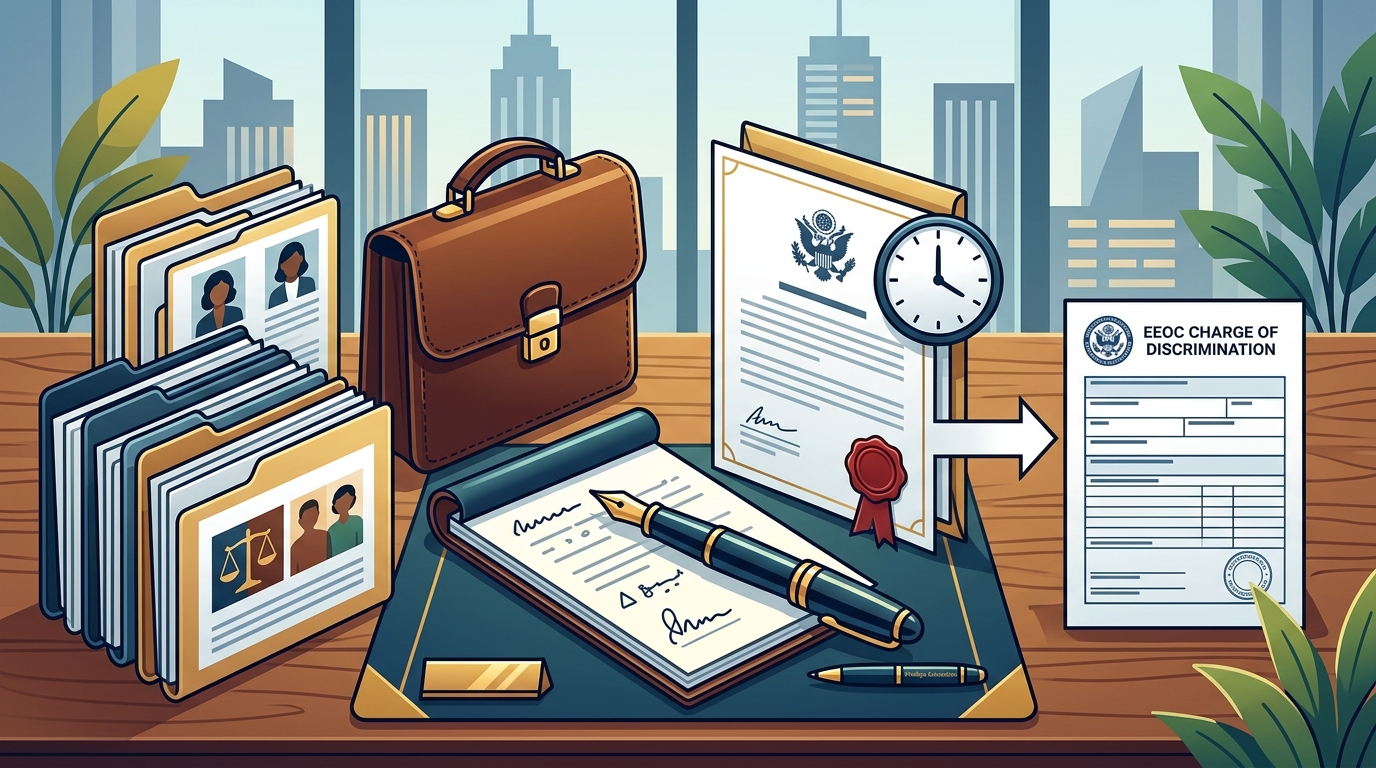
Filing an EEOC charge without legal representation carries significant risks. One of the most common pitfalls is missing critical deadlines. As noted, the deadline to file in New York is 300 days from the date of the discriminatory act. If you miss this deadline, you may lose your right to pursue a claim entirely. An attorney can ensure that all filings are made within the required timeframes.
Another risk is failing to properly articulate the legal theory of your claim. The EEOC may dismiss your charge if it does not clearly state a violation of the law. For example, if you allege racial discrimination but fail to connect the adverse action to your race, the charge may be deemed insufficient. An attorney can help you frame your claim in a way that aligns with legal standards and precedents.
Additionally, without legal counsel, you may not be aware of all the evidence you need to collect. This can weaken your case and make it harder to prove your claim. An attorney can guide you on what evidence is relevant and how to preserve it. They can also help you identify witnesses who can support your case.
Finally, the settlement process can be complex. Employers may offer a settlement that appears generous but contains hidden clauses that limit your future employment opportunities or waive your right to pursue other claims. An attorney can review any settlement offer and negotiate terms that protect your interests and provide adequate compensation.
Legal Representation Comparison
| Factor | Self-Representation | With Legal Counsel |
|---|---|---|
| Deadline Management | High risk of missing deadlines | Strict adherence to statutory deadlines |
| Evidence Preservation | Relies on employer cooperation | Litigation holds and proactive gathering |
| Legal Theory | May lack precision and depth | Strategically framed for maximum impact |
| Mediation Outcome | May accept inadequate settlements | Negotiates comprehensive and fair terms |
| State vs. Federal Claims | Often overlooks state protections | Leverages NYSHRL and NYCHRL advantages |
Key Takeaways
- Deadline Criticality: The 300-day filing deadline in New York is strict and non-negotiable without good cause.
- State Law Superiority: New York State and City laws often provide broader protections and higher damages than federal law.
- Evidence Preservation: Early legal intervention is crucial for securing evidence before it is destroyed.
- Strategic Filing: Choosing the right agency (EEOC, DHR, or CCHR) can significantly impact the case outcome.
- Settlement Negotiation: Legal counsel ensures that settlement agreements do not waive critical rights.
- Expertise Value: Phillips & Associates specializes in employment discrimination and has extensive experience in New York courts.
- Consultation Benefit: A free consultation can help you understand the strength of your case and the best course of action.
Frequently Asked Questions
What is the deadline for filing an EEOC charge in New York?
In New York, you generally have 300 days from the date of the alleged discriminatory act to file a charge with the EEOC. This is longer than the standard 180-day deadline in most other states.
Can I file a discrimination claim in both state and federal court?
Yes, you may be able to file with both the EEOC and the New York State Division of Human Rights or the New York City Commission on Human Rights. Your attorney can help you navigate these parallel processes to maximize your rights.
What is the difference between racial discrimination and harassment?
Racial discrimination involves adverse employment actions taken because of your race, such as firing or demotion. Harassment involves unwelcome conduct based on race that creates a hostile work environment. Both are illegal under federal and New York law.
How much does it cost to hire a discrimination lawyer?
Phillips & Associates typically works on a contingency fee basis for discrimination cases, meaning you do not pay upfront fees. The attorney's fees are deducted from the settlement or judgment if the case is successful.
What types of evidence are needed to prove racial discrimination?
Evidence can include emails, performance reviews, witness testimony, comparative data showing how similarly situated employees of different races were treated, and any direct statements of bias.
Can my employer retaliate against me for filing a charge?
No, it is illegal for an employer to retaliate against an employee for filing a discrimination charge or participating in an investigation. Retaliation itself is a separate violation of the law.
What should I do if I experience racial discrimination at work?
Document the incidents, report them to your employer if safe to do so, and consult with an experienced employment discrimination lawyer as soon as possible to protect your rights.
Does Phillips & Associates handle cases outside of New York City?
Yes, Phillips & Associates has offices in New York City, Long Island, White Plains, Philadelphia, Princeton, and Miami, serving clients across the region.
Take Action to Protect Your Rights
If you have experienced racial discrimination in the workplace, do not wait to seek legal advice. The sooner you act, the better your chances of securing a favorable outcome. Phillips & Associates is dedicated to fighting for the rights of employees against unlawful discrimination. Contact us today to schedule a free consultation and learn how we can help you navigate the EEOC filing process and protect your career.
Visit our Contact Us page or call 866-229-9441 to speak with an experienced attorney.