

What to Do If Your Employer Retaliates Against You for Filing a Discrimination Claim
Workplace retaliation is a pervasive issue that affects thousands of employees annually in New York. According to the U.S. Equal Employment Opportunity Commission, retaliation claims have consistently ranked among the most frequently filed charges in recent years, with over 50,000 claims filed in 2023 alone. This data shows that employers often attempt to silence whistleblowers through subtle or overt punitive measures. If you are experiencing adverse actions after reporting discrimination, understanding your legal protections under New York State and Federal law is critical. This guide outlines the immediate steps you must take to protect your career and your rights.
Understanding What Constitutes Retaliation
Retaliation occurs when an employer takes an adverse action against an employee because they engaged in a protected activity. Protected activities include filing a complaint, participating in an investigation, or opposing discriminatory practices. Workplace retaliation is illegal under both federal laws, such as Title VII of the Civil Rights Act, and New York State Human Rights Law. The law recognizes that without protection from retaliation, the primary anti-discrimination statutes would be ineffective.
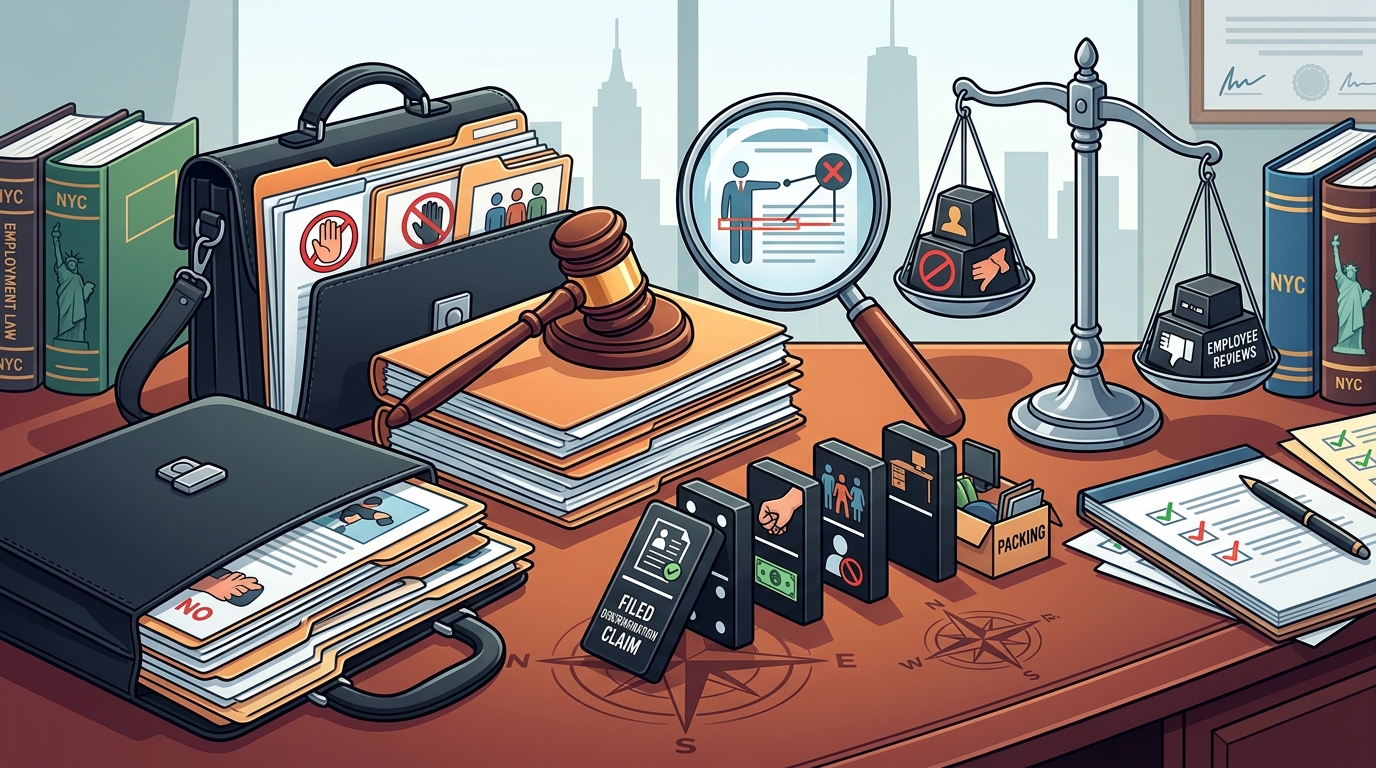
Retaliation is not limited to termination. It encompasses a wide range of adverse actions that might deter a reasonable employee from reporting misconduct. These actions can include demotion, reduction in pay, negative performance reviews, exclusion from meetings, or increased scrutiny of your work. Hostile Work Environment claims often overlap with retaliation when the employer creates an intimidating atmosphere to punish the complainant.
It is important to establish a causal link between your protected activity and the adverse action. If the retaliation occurs shortly after you file a complaint, the timing itself can serve as strong evidence of retaliatory intent. Phillips & Associates specializes in proving these causal connections in complex employment disputes.
Immediate Steps to Protect Your Rights
When you suspect retaliation, time is of the essence. New York State has strict statutes of limitations for filing discrimination and retaliation claims. Under the New York State Human Rights Law, you generally have three years to file a complaint with the Division of Human Rights. However, federal claims often have shorter deadlines, typically 180 to 300 days depending on the state agency involved.
First, review your employee handbook and company policies regarding internal reporting. While you are not always required to exhaust internal remedies before filing a legal claim, doing so can sometimes strengthen your case by demonstrating good faith. However, be cautious. If you believe the internal process is compromised or will lead to further retaliation, consulting with an experienced New York Employment Discrimination Lawyer immediately is the safest course of action.
Second, do not resign voluntarily unless absolutely necessary. Resigning can complicate your claim for back pay and reinstatement. If you feel forced to leave due to the hostile conditions, this may constitute a constructive discharge. A constructive discharge occurs when working conditions become so intolerable that a reasonable person would feel compelled to resign. This is treated legally as a termination.
Third, communicate in writing. If your employer discusses the retaliation with you, follow up with an email summarizing the conversation. This creates a paper trail that can be used as evidence later. Avoid emotional confrontations. Keep your interactions professional and factual to maintain your credibility.
Documenting the Hostile Environment
Documentation is the backbone of any successful retaliation claim. You must gather evidence that links the adverse actions to your protected activity. This includes saving copies of performance reviews, emails, and memos that show a sudden change in your treatment. If you received positive reviews prior to your complaint and negative reviews afterward, this discrepancy is significant.
Keep a detailed personal log of all retaliatory incidents. Record the date, time, location, people involved, and exactly what was said or done. Note any witnesses who observed the behavior. This contemporaneous documentation is often more reliable than memory alone. Courts and administrative agencies place high value on records created at the time of the event.
Preserve all evidence of your protected activity. Save copies of your original discrimination complaint, any responses from HR, and records of meetings where you discussed the issue. If you filed a complaint with a government agency, keep a copy of the receipt or confirmation. These documents prove that you engaged in protected conduct.
Do not delete any work-related communications. Even if they are unfavorable, they may provide context for your employer's actions. If your employer threatens to delete records, notify your attorney immediately. Spoliation of evidence can lead to severe legal penalties for the employer.
Filing Administrative and Legal Claims
Before you can file a lawsuit in court, you typically must exhaust administrative remedies. This means filing a charge with the appropriate government agency. For federal claims, this is the Equal Employment Opportunity Commission (EEOC). For New York State claims, you file with the New York State Division of Human Rights (DHR) or the New York City Commission on Human Rights (NYCHRC) if you are in NYC.
Filing with the NYCHRC is particularly powerful because New York City Human Rights Law offers broader protections than state or federal law. It covers smaller employers and has a longer statute of limitations. The Commission on Human Rights provides a robust framework for addressing Workplace Retaliation and discrimination in the city.
Once the administrative process is complete, you will receive a Notice of Right to Sue. This document allows you to file a civil lawsuit in state or federal court. The litigation process involves discovery, where both sides exchange evidence, and potentially mediation or trial. Phillips & Associates has a proven track record of securing favorable outcomes for clients in these proceedings.
Whistleblower Retaliation is another specific category of claims. If you reported illegal activity, such as fraud or safety violations, you may have additional protections under laws like the New York Labor Law. These laws provide specific remedies for employees who report misconduct.
Potential Damages and Remedies
If you win your retaliation claim, you may be entitled to several types of relief. Back pay is a common remedy, compensating you for the wages and benefits you lost due to the retaliation. Front pay may also be awarded if reinstatement is not feasible. This compensates you for future lost earnings.
Compensatory damages cover emotional distress, pain and suffering, and other non-economic harms. Punitive damages may be awarded if the employer's conduct was particularly malicious or reckless. In New York, punitive damages are available under certain conditions and can significantly increase the total recovery.
Attorney's fees and costs are also recoverable in many employment discrimination cases. This means that if you prevail, your employer may have to pay for your legal representation. This provision encourages employees to pursue valid claims without fear of prohibitive legal costs.
Reinstatement is another potential remedy. If you were fired, the court may order your employer to give you your job back. However, in cases of severe retaliation, reinstatement may not be in the best interest of the employee. In such cases, a substantial monetary settlement is often the preferred outcome.
Key Takeaways
- Retaliation is Illegal: Employers cannot punish employees for reporting discrimination under NY State or Federal law.
- Act Quickly: Statutes of limitations are strict. File administrative charges within 180 to 300 days for federal claims and up to 3 years for NY State claims.
- Document Everything: Keep detailed logs of retaliatory acts and preserve all written communications.
- Causal Link: Prove that the adverse action was motivated by your protected activity.
- Consult an Attorney: Early legal counsel can help you navigate complex procedural requirements and protect your rights.
- Broader Protections: NYC Human Rights Law offers expanded protections for employees in New York City.
- Recovery Options: You may be entitled to back pay, front pay, compensatory damages, and attorney's fees.
Frequently Asked Questions
What is the statute of limitations for filing a retaliation claim in New York?
For New York State Human Rights Law claims, you generally have three years from the date of the retaliatory act. For federal claims, the deadline is typically 180 days, or 300 days if a state agency enforces a similar law.
Can I be fired for filing a discrimination complaint?
No. Firing an employee for filing a discrimination complaint is illegal retaliation. If you are terminated for this reason, you have a strong case for wrongful termination and retaliation.
What counts as evidence of retaliation?
Evidence includes negative performance reviews, sudden changes in duties, exclusion from meetings, verbal warnings, or termination that occurs shortly after you filed a complaint. Timing is a critical factor.
Do I need to hire a lawyer to file a claim?
While you can file administrative charges on your own, hiring an experienced employment discrimination lawyer is highly recommended. Legal expertise is crucial for navigating complex procedures and maximizing your recovery.
What if the retaliation is subtle, like being ignored?
Subtle retaliation can be harder to prove but is still actionable. If being ignored or excluded is part of a pattern of adverse treatment linked to your complaint, it may constitute retaliation. Documentation is key.
Can my employer force me to sign an NDA?
Employers often try to use NDAs to silence employees. However, recent laws, including the Adult Survivors Act and federal guidelines, restrict the use of NDAs in cases involving sexual harassment and discrimination. Consult a lawyer to review any settlement agreements.
What damages can I recover?
You may recover back pay, front pay, compensatory damages for emotional distress, punitive damages, and attorney's fees. The amount depends on the severity of the retaliation and the impact on your career.
Contact Phillips & Associates
If you are facing retaliation for filing a discrimination claim, do not wait. The longer you wait, the more difficult it becomes to gather evidence and meet legal deadlines. Phillips & Associates is dedicated to protecting the rights of employees in New York, New Jersey, and Pennsylvania. Our team has extensive experience handling complex Workplace Retaliation cases.
We offer free consultations to discuss your situation. Contact us today at 866-229-9441 or visit our Contact Us page to schedule a meeting. We are here to help you fight for justice and hold your employer accountable.