

How to File an EEOC Charge for Racial Discrimination in the Workplace
If you have experienced racial discrimination at work, filing a charge with the Equal Employment Opportunity Commission (EEOC) is often the critical first step toward holding your employer accountable. In fiscal year 2024, the EEOC received 88,531 new charges of discrimination, with race discrimination accounting for 34.2% of all filings. For New York employees, the process involves strict deadlines, specific filing options, and strategic decisions that can shape the outcome of your case. Below, our New York racial discrimination attorneys explain every step you need to take.
What Is an EEOC Charge of Discrimination?
An EEOC charge of discrimination is a formal complaint filed with the Equal Employment Opportunity Commission alleging that an employer violated federal anti-discrimination laws. The EEOC is the federal agency tasked with enforcing Title VII of the Civil Rights Act of 1964 and other workplace protections. Filing a charge is a mandatory prerequisite before you can bring a federal lawsuit for racial discrimination under Title VII.
The charge itself is completed on EEOC Form 5, which asks for your identifying information, your employer's details, the dates of the discriminatory acts, and a written narrative describing what happened.
Grounds for Filing a Racial Discrimination Charge
Racial discrimination is any adverse employment action taken because of your race, color, or association with someone of a particular race. Under federal law, it is illegal for employers with 15 or more employees to discriminate based on race in hiring, firing, compensation, promotions, or any term or condition of employment.
Common Examples of Racial Discrimination
Discrimination can be overt or subtle. Common scenarios include being passed over for promotion in favor of less-qualified colleagues, receiving harsher discipline than peers of a different race, or being subjected to a race-based hostile work environment. Racial slurs, offensive symbols, and derogatory jokes directed at your race can all form the basis of a charge.
Disparate Treatment vs. Hostile Work Environment
Disparate treatment is when an employer treats you differently because of your race through specific adverse actions. A hostile work environment claim arises when racially offensive conduct is so severe or pervasive that it alters the conditions of your employment. Both types of racial discrimination can support an EEOC charge.
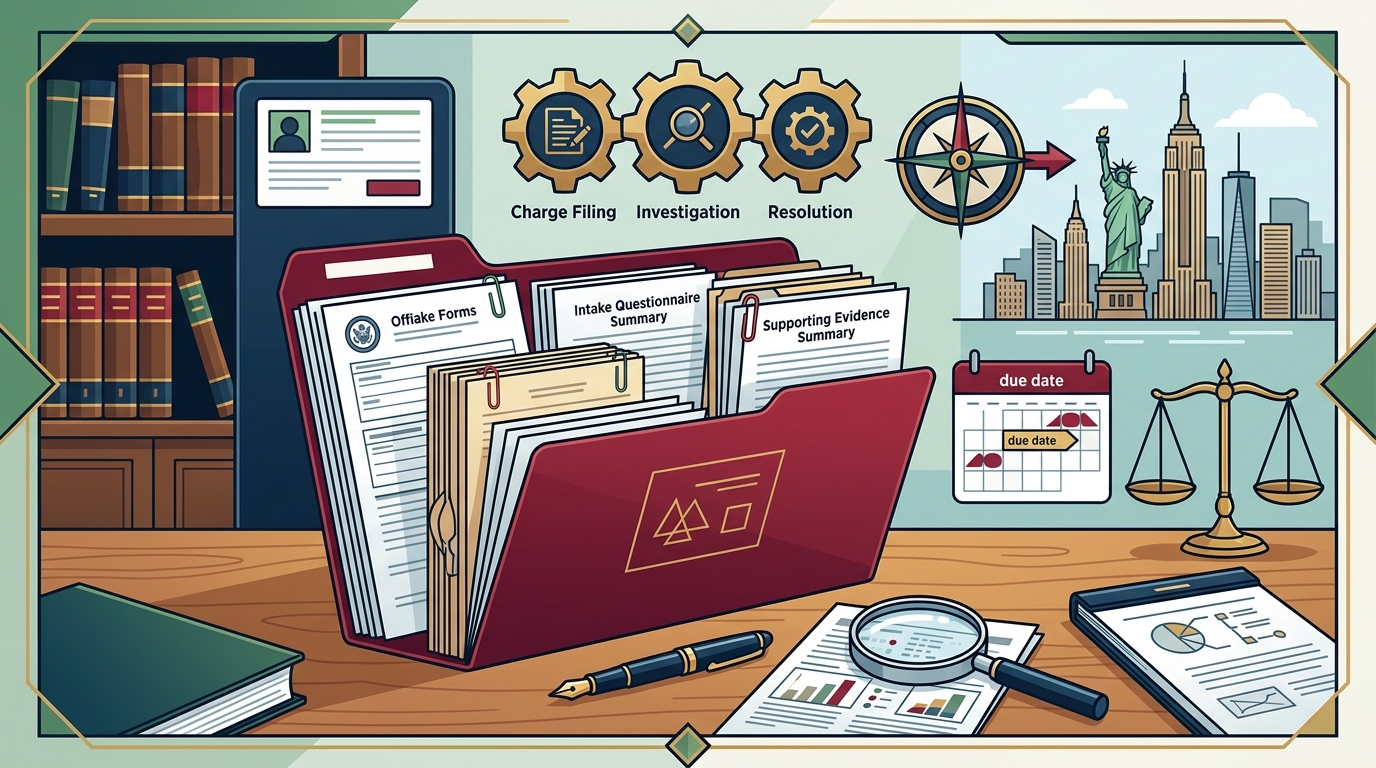
Step-by-Step: How to File Your EEOC Charge
Step 1: Document Everything
Before filing, gather all evidence of the discrimination. Save emails, text messages, performance reviews, and witness contact information. Written documentation strengthens your charge and gives the EEOC investigator concrete facts. Our guide on how to document a hostile work environment offers practical tips.
Step 2: Submit an Inquiry Through the EEOC Public Portal
The EEOC encourages employees to begin the process online at publicportal.eeoc.gov. You will answer a series of questions about your situation and provide a factual narrative covering who discriminated against you, what happened, when it occurred, where it took place, and who witnessed it. You may also visit the New York District Office at 33 Whitehall Street, 5th Floor, New York, NY 10004.
Step 3: Sign and File the Formal Charge
After your initial inquiry, the EEOC will schedule an interview. Following that interview, you or your attorney will review and sign the formal charge. An employee can file the charge independently or hire an attorney to file on their behalf. Having an experienced racial discrimination lawyer draft the charge helps ensure the narrative is legally precise and strategically framed.
| Method | How It Works | Best For |
|---|---|---|
| Online (Public Portal) | Submit inquiry and upload documents digitally | Most filers; available 24/7 |
| In Person | Walk-in or appointment at EEOC district office | Complex cases; those without internet access |
| By Mail | Send signed, written charge to nearest EEOC office | Remote filers; those with limited mobility |
| Through an Attorney | Lawyer files via portal or directly with EEOC | Strategic filings; tight deadlines |
Filing Deadlines New York Employees Must Know
Timing is critical. Under federal law, a charge of discrimination must be filed within 180 days of the discriminatory act. However, because New York has state and local anti-discrimination agencies, this deadline extends to 300 days from the date of alleged harm for charges filed with the New York District Office against employers with 15 or more employees.
Missing the deadline can permanently bar your federal claim. If you believe you have been subjected to racist comments or behavior at work, consult an attorney as soon as possible to preserve your rights.
What Happens After You File
Once the EEOC receives your charge, it will notify your employer and begin an investigation. On average, the EEOC takes approximately 10 months to investigate a charge, though mediation can resolve matters in under three months. During the investigation, the agency may interview witnesses, review employer documents, and conduct site visits.
After investigating, the EEOC reaches one of several outcomes:
- Conciliation: If the EEOC finds reasonable cause, it attempts to resolve the matter through informal negotiation with your employer.
- Litigation: If conciliation fails, the EEOC may file a federal lawsuit on your behalf.
- Right-to-Sue Letter: If the EEOC dismisses the charge or cannot resolve it, it issues a Notice of Right to Sue (NRTS), giving you 90 days to file a lawsuit in federal court.
You may also request a right-to-sue letter 180 days after filing your charge, even if the investigation is not complete. Learn more about what to do after receiving a right-to-sue letter.
New York State and City Alternatives to the EEOC
New York employees have additional options beyond the EEOC. The New York State Human Rights Law and the New York City Human Rights Law both prohibit racial discrimination, and in many cases offer broader protections. The NYC Human Rights Law applies to employers with four or more employees, compared to Title VII's 15-employee threshold.
When you file with the EEOC, a work-sharing agreement allows dual filing with the New York State Division of Human Rights, so you do not need to file separately with both agencies. An attorney can advise whether filing under state, city, or federal law provides the strongest remedies for your specific circumstances.
Key Takeaways
- An EEOC charge is a required step before filing a federal racial discrimination lawsuit under Title VII.
- New York employees generally have 300 days from the discriminatory act to file a charge with the EEOC.
- You can file online through the EEOC Public Portal, in person at the New York District Office, by mail, or through an attorney.
- The EEOC investigation averages about 10 months, but mediation may resolve cases in under three months.
- Race discrimination accounted for 34.2% of all EEOC charges in fiscal year 2024.
- New York State and City human rights laws may provide broader protections than federal law, especially against smaller employers.
- Consulting a racial discrimination attorney early protects your deadlines and strengthens your filing.
Frequently Asked Questions
What qualifies as racial discrimination under the EEOC?
Racial discrimination includes any adverse employment action based on your race or color, such as termination, demotion, unequal pay, denial of promotion, or harassment that creates a hostile work environment. It also covers discrimination based on your association with someone of a particular race.
How long do I have to file an EEOC charge in New York?
In New York, you generally have 300 days from the date of the discriminatory act to file a charge with the EEOC. The standard federal deadline is 180 days, but the extended period applies because New York has state and local anti-discrimination agencies.
Can I file an EEOC charge without a lawyer?
Yes, you can file a charge on your own through the EEOC Public Portal or at a local office. However, working with an experienced employment discrimination attorney can help you draft a stronger narrative, meet deadlines, and position your case strategically from the start.
What happens if the EEOC dismisses my charge?
If the EEOC dismisses your charge, it will issue a Notice of Right to Sue, giving you 90 days to file a lawsuit in federal court. A dismissal does not mean your claim lacks merit. Further discovery in court can uncover evidence the EEOC did not consider.
How long does an EEOC investigation take?
The average EEOC investigation takes approximately 10 months. Cases that go through the EEOC's mediation program are often resolved in less than three months.
Can I file with the EEOC and New York State at the same time?
Yes. The EEOC has a work-sharing agreement with the New York State Division of Human Rights that allows dual filing. When you file your EEOC charge, you can request that it be cross-filed with the state agency automatically.
What remedies can I receive in a racial discrimination case?
Remedies may include back pay, front pay, compensatory damages for emotional distress, punitive damages, reinstatement, and injunctive relief requiring the employer to change its practices. The specific remedies depend on whether you proceed under federal, state, or city law.
Does my employer have to have a certain number of employees?
Title VII applies to employers with 15 or more employees. If your employer has fewer than 15 workers, you may still have a claim under the New York City Human Rights Law, which covers employers with four or more employees.
Protect Your Rights: Talk to a Racial Discrimination Lawyer Today
If you are facing racial discrimination at work, do not wait until deadlines pass. The New York employment discrimination attorneys at Phillips & Associates have recovered over $300 million for victims of workplace discrimination and harassment. Schedule your free, confidential consultation today by calling (866) 229-9441 or filling out our online contact form.