

What to Do If Your Employer Retaliates Against You for Filing a Discrimination Claim
Filing a discrimination complaint takes courage. When your employer punishes you for exercising that right, the law calls it retaliation, and it is illegal under federal, state, and New York City law. Retaliation is the most common type of charge filed with the Equal Employment Opportunity Commission, accounting for 42,301 charges in fiscal year 2024 alone. If you are experiencing adverse treatment after reporting discrimination, you need to understand your legal options, document what is happening, and act quickly. This guide walks you through the steps to protect yourself and pursue justice in New York.
What Is Workplace Retaliation?
Workplace retaliation is an adverse action an employer takes against an employee for engaging in a legally protected activity. Protected activity includes filing a discrimination complaint, participating in an investigation, reporting harassment, or requesting a reasonable accommodation. The concept is straightforward: the law wants workers to feel safe speaking up without fear of punishment.
According to the EEOC's 2024 Annual Performance Report, the agency received 88,531 new discrimination charges that fiscal year, a 9% increase over 2023. Retaliation charges totaled 42,301 and were the most prevalent filing category for the seventeenth consecutive year. These numbers highlight how widespread the problem remains.
Laws That Protect You in New York
New York employees benefit from three overlapping layers of legal protection against retaliation. Understanding which law applies to your situation can significantly affect your case strategy and potential recovery.
Federal Protection Under Title VII
Title VII of the Civil Rights Act of 1964 prohibits employers from retaliating against employees who report discrimination based on race, color, gender, national origin, pregnancy, or religion. To pursue a federal claim, you must first file a charge with the EEOC. Under federal law, you must show that retaliation was the "but for" cause of the adverse action, meaning the action would not have occurred without the retaliatory motive.
New York State Human Rights Law (NYSHRL)
The NYSHRL mirrors federal protections but covers a slightly broader range of categories. It applies to all employers in New York State. As of recent amendments, the statute of limitations for NYSHRL claims is now three years, giving workers more time to bring a discrimination or retaliation lawsuit.
New York City Human Rights Law (NYCHRL)
The NYCHRL is one of the broadest anti-discrimination laws in the country. Unlike federal law, the NYCHRL prohibits retaliation in any manner, and there need not be an ultimate action or material change in the terms of employment. Workers only need to show that retaliation played a part in the negative employment action, a significantly lower bar than the federal "but for" standard.
| Feature | Title VII (Federal) | NYSHRL (State) | NYCHRL (City) |
|---|---|---|---|
| Causation Standard | "But for" cause | "But for" cause | Motivating factor |
| Employer Size Threshold | 15+ employees | All employers | 4+ employees |
| Statute of Limitations | 300 days (EEOC filing) | 3 years | 3 years |
| Scope of Adverse Action | Materially adverse | Materially adverse | Any retaliatory conduct |
Common Forms of Employer Retaliation
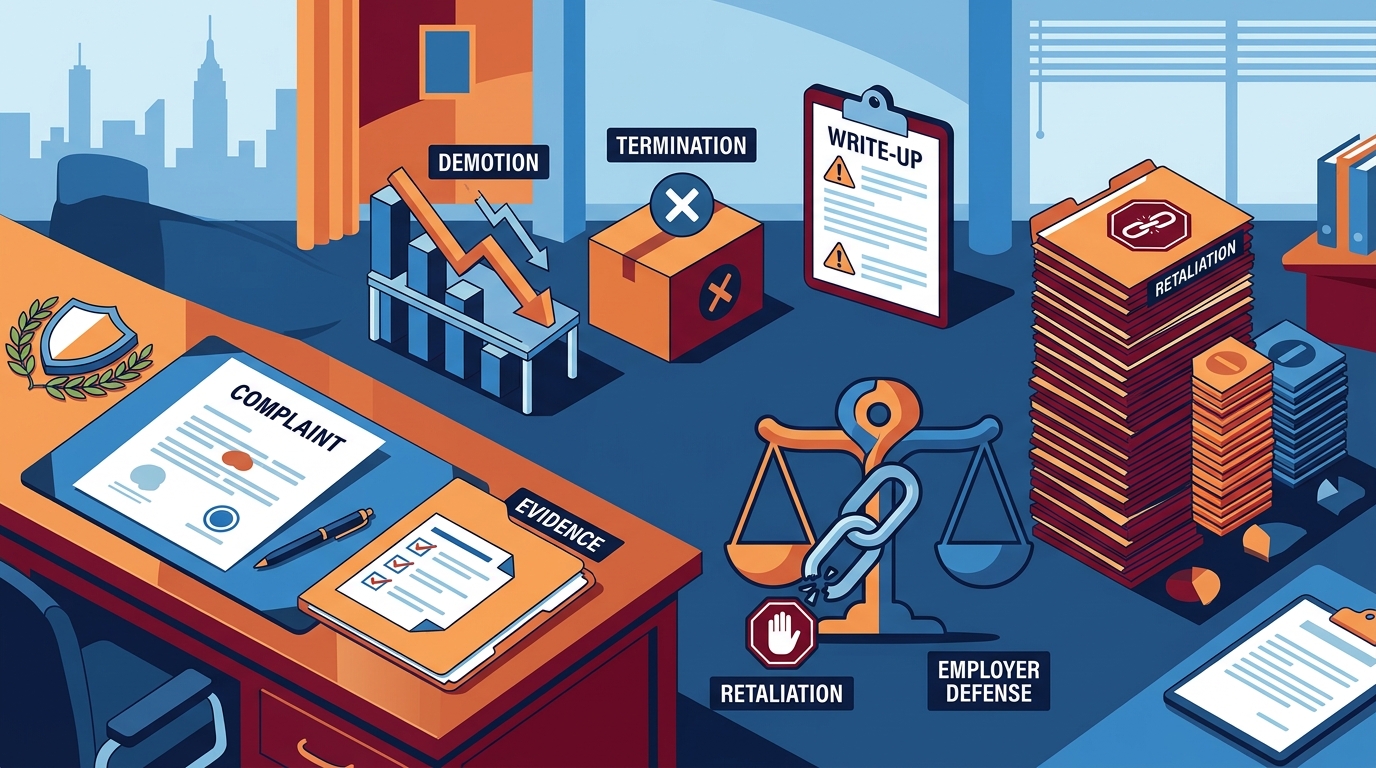
Retaliation is not always as obvious as being fired the day after you complain. It can take many forms, some subtle enough that employees do not immediately recognize them as retaliation. Common examples include termination, demotion, pay cuts, reduced hours, unfavorable reassignments, negative performance reviews, and exclusion from meetings or projects.
Less obvious forms include increased scrutiny of your work, being moved to a less desirable shift, having your responsibilities stripped, or being subjected to a sudden pattern of write-ups that did not exist before your complaint. Under the NYCHRL, even these subtler actions may qualify as illegal retaliation after a discrimination complaint.
Steps to Take Immediately After Retaliation
1. Document Everything
Begin keeping detailed records the moment you notice a change in your treatment. Save emails, text messages, performance reviews, schedules, and any written communications. Note dates, times, witnesses, and what was said. A strong paper trail is one of the most powerful tools in a retaliation case.
2. Report the Retaliation Internally
File a written complaint with your Human Resources department. While HR often represents the employer's interests, a written internal complaint creates a record that your employer was put on notice. This step can also strengthen the causal connection between your protected activity and the adverse action.
3. Consult an Employment Attorney
Retaliation cases involve nuanced legal standards and strict deadlines. An experienced New York workplace retaliation lawyer can evaluate your evidence, advise you on which legal framework offers the strongest claim, and help you avoid procedural pitfalls that could derail your case.
How to Prove Retaliation in the Workplace
To establish a retaliation claim, you generally need to demonstrate three elements: (1) you engaged in a protected activity, (2) your employer took an adverse action against you, and (3) a causal connection links the protected activity to the adverse action. This causal nexus is often the most contested element in court.
Timing is frequently a key piece of evidence. If you were terminated within a week of filing a harassment complaint with HR, the close proximity between the complaint and the firing creates a strong inference of retaliation. Courts also examine whether your employer's stated reason for the adverse action is pretextual. For example, if your employer suddenly claims poor performance when your reviews were consistently positive before your complaint, that shift can serve as powerful evidence.
Under the NYCHRL, workers in New York City benefit from a more lenient standard for retaliation claims. City law does not require you to prove that the employer's stated reason was entirely false; you only need to show retaliation was a motivating factor.
Where to File a Retaliation Complaint
You have several options for filing a formal retaliation complaint, depending on the law under which you choose to proceed.
Equal Employment Opportunity Commission (EEOC): Filing with the EEOC is required before pursuing a federal lawsuit under Title VII. In New York, you generally have 300 days from the retaliatory act to file. If you receive a Right to Sue letter from the EEOC, you have only 90 days to file a lawsuit in federal court.
New York State Division of Human Rights (NYSDHR): This agency enforces the NYSHRL and offers an alternative to the federal process. Note that under New York's election of remedies provision, filing with the NYSDHR may affect your ability to later file in state court.
New York City Commission on Human Rights (CCHR): If you work in New York City, you can file directly with the NYC Commission on Human Rights. The NYCHRL protects you as long as you had a reasonable, good-faith belief that your employer's conduct was illegal, even if your original discrimination claim is not ultimately proven.
Key Takeaways
- Retaliation is illegal under federal, New York State, and New York City law whenever an employer punishes you for engaging in a protected activity such as filing a discrimination claim.
- The NYCHRL provides broader protection than federal law, requiring only that retaliation was a motivating factor and covering employers with as few as four employees.
- Retaliation charges were the most common EEOC filing for 17 consecutive years, with 42,301 charges in fiscal year 2024.
- Document every adverse change in your employment immediately: save emails, note dates, and preserve performance reviews.
- Report the retaliation in writing to HR to create an internal record before filing an external complaint.
- Strict deadlines apply: 300 days for EEOC charges, 90 days after receiving a Right to Sue letter, and three years for NYSHRL and NYCHRL claims.
- Consult an experienced New York employment attorney as early as possible to protect your rights and strengthen your case.
Frequently Asked Questions
What qualifies as retaliation under New York law?
Retaliation is any adverse action your employer takes against you because you engaged in a protected activity. Protected activity includes filing a discrimination complaint, participating in an investigation, reporting harassment, or requesting a workplace accommodation. Under the NYCHRL, even subtle actions like exclusion from projects or increased scrutiny may qualify.
Can I file a retaliation claim even if my original discrimination complaint was not proven?
Yes. The law protects you as long as you had a reasonable, good-faith belief that discrimination occurred. A court may dismiss your discrimination claim on technical grounds yet still allow your retaliation claim to proceed.
How long do I have to file a retaliation complaint in New York?
Deadlines vary by law. For federal claims, you must file with the EEOC within 300 days. For claims under the NYSHRL or NYCHRL, you generally have three years to file a lawsuit. After receiving an EEOC Right to Sue letter, you have just 90 days to file in federal court.
What evidence do I need to prove workplace retaliation?
You need evidence showing you engaged in a protected activity, your employer took an adverse action, and a causal connection links the two. Timing, prior positive performance reviews, inconsistent explanations from your employer, and witness testimony are all valuable evidence.
Is it retaliation if my employer gives me a bad performance review after I file a complaint?
It can be. If your reviews were consistently positive before your complaint and suddenly became negative without a legitimate explanation, that change may constitute retaliation. Courts examine whether the negative review is pretextual.
What damages can I recover in a New York retaliation case?
Potential damages include back pay, front pay, compensatory damages for emotional distress, punitive damages, and attorney's fees. In some cases, you may also obtain reinstatement to your former position or policy changes at your workplace.
Should I report retaliation to HR before contacting a lawyer?
Filing a written complaint with HR creates a helpful internal record, but it is wise to consult an attorney first or simultaneously. An employment lawyer can advise you on how to frame your complaint and what to include to strengthen your case.
Does the NYCHRL offer stronger protections than federal law?
Yes. The NYCHRL uses a lower causation standard, covers employers with four or more employees, and prohibits retaliation "in any manner" rather than limiting claims to materially adverse actions. Many employees in New York City find they have stronger claims under city law.
Protect Your Rights Today
If your employer has retaliated against you for filing a discrimination claim, time is not on your side. Phillips & Associates has recovered over $300 million for victims of workplace discrimination and harassment. Contact our New York retaliation lawyers for a free, confidential consultation. Call (866) 229-9441 or reach out online to discuss your case today.