

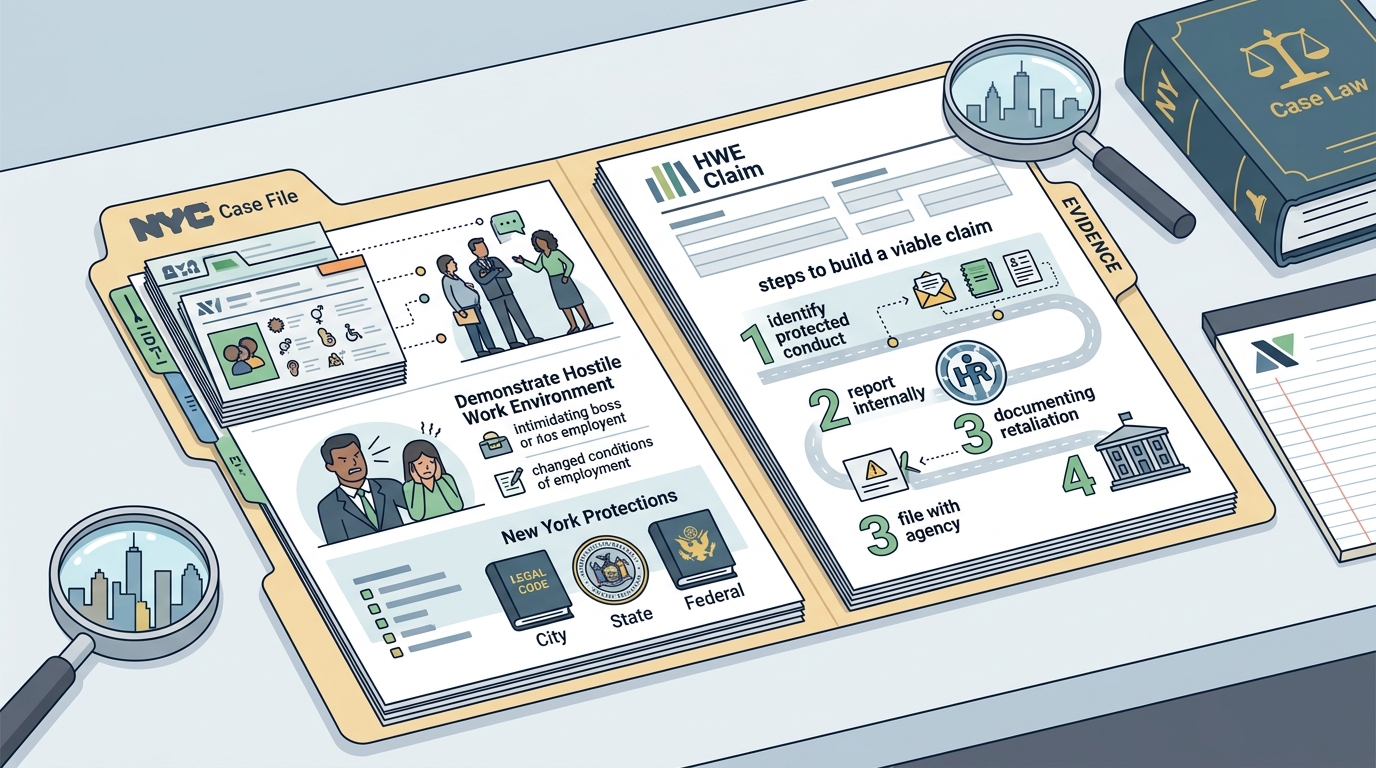
Proving a hostile work environment in New York requires more than showing your job is stressful or your boss is difficult. You need to demonstrate that unlawful harassment tied to a protected characteristic changed the conditions of your employment. New York employees benefit from some of the strongest worker protections in the country under federal, state, and city laws. Below, we break down each step you must take to build a viable hostile work environment claim, from identifying protected conduct to filing with the right agency. Phillips & Associates has recovered over $300 million for victims of workplace discrimination and harassment across New York City.
What Is a Hostile Work Environment Under New York Law?
A hostile work environment is a form of workplace harassment in which offensive conduct based on a protected characteristic is so severe or pervasive that it alters the conditions of employment and creates an abusive atmosphere. It is not limited to extreme behavior like physical threats. Repeated slurs, offensive images, derogatory jokes, or unwanted physical contact can all contribute to a legally actionable claim.
Importantly, you do not have to be fired or suffer an economic loss to have a valid claim. Even a bystander who witnesses discriminatory conduct directed at a coworker may have standing. Learn more about what you can do about a hostile work environment.
Federal, State, and City Laws That Apply
Three overlapping legal frameworks protect New York workers from hostile work environments.
| Law | Employer Size Threshold | Standard of Proof | Statute of Limitations |
|---|---|---|---|
| Title VII of the Civil Rights Act of 1964 | 15+ employees | Severe or pervasive | 300 days (EEOC filing) |
| New York State Human Rights Law (NYSHRL) | 4+ employees (all employers for sexual harassment) | More than petty slights or trivial inconveniences | 3 years |
| New York City Human Rights Law (NYCHRL) | 4+ employees (all employers for sexual harassment) | Treated "less well" because of a protected characteristic | 3 years |
The NYCHRL is the most employee-friendly standard. Unlike federal law, it does not require a showing that harassment was "severe or pervasive." It only requires proof that you were treated less well than others due to a protected trait and that the conduct exceeded petty slights. This distinction was strengthened by amendments to the city and state human rights laws that broadened protections beyond the federal Title VII framework.
Key Elements You Must Prove
1. Membership in a Protected Class
A protected class is a group of people shielded by anti-discrimination law based on characteristics such as race, sex, gender identity, sexual orientation, religion, national origin, disability, age, pregnancy, or marital status. New York State law protects more categories than federal law, including caregiver status and status as a victim of domestic violence. If harassment is not tied to a protected characteristic, it is generally not actionable, no matter how unpleasant.
2. Unwelcome Conduct That Is Severe or Pervasive
Under federal and state law, you must show that the behavior was objectively hostile (a reasonable person would find it abusive) and subjectively hostile (you personally found it abusive). A single incident can qualify if it is extraordinarily severe, such as a physical assault or the use of a racial epithet by a supervisor. Read about how courts analyze the severe or pervasive standard in race-based claims.
3. Basis for Employer Liability
Employer liability is the legal principle that holds a company responsible for the harassment. When a supervisor creates the hostile environment, the employer can be held strictly liable if the harassment leads to a tangible employment action such as termination or demotion. When a coworker is the harasser, you must show that the employer knew or should have known about the conduct and failed to take corrective action.
Step 1: Document Everything
Strong documentation is the foundation of any hostile work environment case. You should keep a contemporaneous journal recording dates, times, locations, the identity of the harasser, exact quotes when possible, and the names of any witnesses. Save emails, text messages, photographs, and any other physical evidence.
Phillips & Associates recommends beginning documentation early, even before you are certain you want to take legal action. Our detailed guide on how to document a hostile work environment walks you through every detail you should capture.
Step 2: Report Through Internal Channels
Before pursuing external remedies, use your employer's grievance procedures. Check your employee handbook for reporting instructions, or go directly to Human Resources. Make your report in writing, and keep a copy for your records.
Reporting matters legally. Under Title VII, an employer may avoid liability if it can demonstrate that it took reasonable steps to prevent and correct harassment and that you unreasonably failed to use available internal procedures. Reporting also establishes a timeline that can support a later retaliation claim if your employer punishes you for speaking up.
Step 3: File a Formal Complaint
If internal reporting does not resolve the situation, you can file a formal complaint with an external agency.
- EEOC: For federal claims under Title VII, file within 300 days of the most recent harassing act. Learn more about the EEOC complaint process and probable cause findings.
- New York State Division of Human Rights: File within three years under the NYSHRL.
- NYC Commission on Human Rights: File within three years under the NYCHRL.
You may also bypass the administrative process and file a lawsuit directly in court under state or city law. An experienced employment attorney can help you choose the venue that maximizes your protections and potential damages.
Damages You Can Recover
Victims of a hostile work environment may pursue several categories of damages:
- Compensatory damages: Lost wages, medical expenses, and compensation for emotional distress.
- Punitive damages: Awarded to punish employers who acted recklessly or maliciously. Under federal law, these are capped based on employer size (up to $300,000). Under the NYCHRL, there are no caps on punitive damages.
- Injunctive relief: Court orders requiring the employer to change policies or reinstate a terminated employee.
- Attorney's fees: Recoverable under all three laws if you prevail.
Phillips & Associates has secured results including a $2.2 million verdict in a race discrimination and retaliation case and a $1.8 million verdict in the Southern District of New York.
Key Takeaways
- A hostile work environment requires unwelcome conduct tied to a protected characteristic that alters working conditions.
- New York City and State laws set a lower bar than federal Title VII, making claims easier to pursue locally.
- You do not need to be fired or suffer economic harm to have a valid claim.
- Document incidents immediately with dates, quotes, witnesses, and physical evidence.
- Report harassment through internal channels first to preserve your legal options.
- File external complaints within applicable deadlines: 300 days for the EEOC, three years for state and city claims.
- An employment lawyer can help you choose the best legal strategy and maximize your recovery.
Frequently Asked Questions
What qualifies as a hostile work environment in New York?
A hostile work environment exists when harassment based on a protected characteristic, such as race, sex, or disability, is severe or pervasive enough to change the conditions of your employment. Under the NYCHRL, conduct only needs to exceed "petty slights" to be actionable.
Do I need to be fired to sue for a hostile work environment?
No. You can bring a hostile work environment claim even if you are still employed. The law protects employees who experience abusive conditions, not just those who lose their jobs.
Can a single incident create a hostile work environment?
Yes, if the incident is extraordinarily severe. Courts have found that a single use of a racial slur by a supervisor, or a single instance of unwanted contact with an intimate body part, can be enough to state a claim.
What is the difference between the federal and NYC standards?
Federal law requires conduct that is "severe or pervasive." The NYC Human Rights Law uses a broader standard: you need only show you were treated "less well" because of a protected characteristic and that the conduct was more than a trivial inconvenience.
How long do I have to file a hostile work environment claim?
Under federal law (Title VII), you must file with the EEOC within 300 days. Under the New York State and City Human Rights Laws, the statute of limitations is three years.
What should I include in my documentation?
Record the date, time, location, what was said or done, who said or did it, any witnesses present, and your emotional reaction. Save emails, texts, photos, and any written complaints you submit to your employer.
Can my employer retaliate against me for complaining?
No. Retaliation is illegal under Title VII, the NYSHRL, and the NYCHRL. If your employer fires, demotes, or otherwise punishes you for reporting harassment, you may have a separate retaliation claim.
Do I need a lawyer to file a hostile work environment claim?
While not legally required, an experienced employment discrimination attorney significantly improves your chances of success. A lawyer can identify which law provides the strongest protections, help you preserve evidence, and negotiate or litigate on your behalf.
Speak With a New York Hostile Work Environment Lawyer Today
If you believe you are experiencing a hostile work environment, do not wait. Evidence fades, witnesses move on, and deadlines pass. The employment attorneys at Phillips & Associates offer free, confidential consultations and charge no fee unless they recover compensation for you. Call (866) 229-9441 or contact Phillips & Associates online to discuss your case today.